
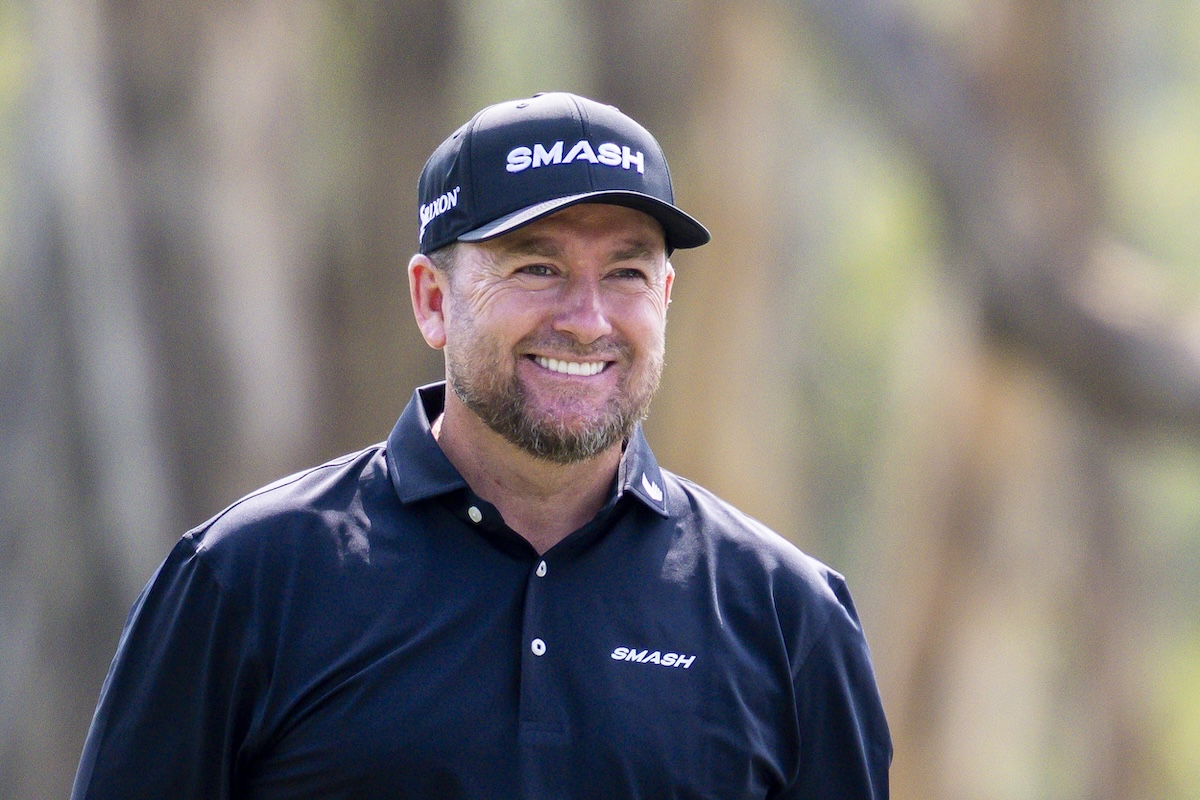









In the wake of the news that the Saudi Public Investment Fund would no longer be financially backing LIV Golf, Graeme McDowell suggested that the removal of the controversial regime from direct control could prove beneficial in the long run by making it more palatable.
“I don’t think we could have ever imagined how deep this would go. The hatred. It’s funny, but if we can shift the narrative away from Saudi Arabia and bring some U.S. money and get rid of that narrative … because that narrative is just nasty,” he told Sports Illustrated’s Bob Harig ahead of LIV Golf Virginia. Adding: “Maybe we can get rid of that and focus on LIV as a viable golfing product.”
McDowell was one of the first crop of players to sign a contract with the breakaway league, and has repeatedly defended his decision, initially making what he admits was the errant and disingenuous claim that it was to help spread the game globally before conceding that it was for financial gain and to extend his playing career.
“I was ready to jump ship and go get a real job,” he said. “And then these guys came along and said, ‘hey, we’re going to do this tour. Do you want to come play?’ I love playing. I love competing. I regret a few things I said in the beginning, stuff like growing the game. I should have just said it for what it was: this is good for my bank account, and I’m getting a runway to play the game of golf for as long as I possibly can.”
For LIV Golf to continue in anything close to its current form, CEO Scott O’Neil has to secure considerable and sufficiently generous benefactors to replace the PIF, and though McDowell recognises the obvious challenge involved, he feels that it was inevitable that this situation would arise.
“Potentially he’s been given some leash now to be able to go and [secure replacement funding],” he said. “I think we all knew that we were going to have to stand on our own two feet at some point to be able to make this into a legitimate business. When you’ve kind of got the type of cash that we had in the beginning for a startup company, it was a little crazy and maybe not very real. It’s kind of like we’re turning 18 now. I’m going to go into the real world. We got to fend for ourselves a little bit. We try to make this into legit business.”
When LIV Golf arrived, it initially staged eight events in 2022 with $20 million individual prizefunds before expanding to 14 in each of the next three years. This season, 14 were again scheduled with the purse increased to $30 million ($20 million for the individual sector), but last week it was announced that the event scheduled for Louisiana in late June had been cancelled.
And McDowell admits that the financial landscape is unsustainable, both on LIV and on the PGA Tour which was forced to evolve in a direct response to LIV’s arrival.
“At the beginning, no doubt, there was a lot of excess,” McDowell said. “It was maybe a little too flashy on some levels. The purse prizes are incredible. I could never imagine. I remember going to WGCs [World Golf Championship events] when I was in my late 20s, early 30s, thinking these are the most unbelievable things I’ve ever heard of, playing for $7 million. It’s insane. And then we’re playing for $20 million out here. The complacency that can come with that is just embarrassing. You obviously adjust to your surroundings and get on with it.”
“It’s like an arms race that no one can continue to fund,” he added.
While he admits that, like so many of his fellow LIV players, he’s very much in the dark about what the future holds, he’s disappointed with the way the general public has reacted to the belief that LIV Golf may be a thing of the past as it would leave certain players without a place to play and many additional people out of work.
Personally though, he feels that LIV has only been positive for his own situation.
“I don’t know where this is going to go,” McDowell said. “There’s a lot of players out here that if this goes away, they’ve got nowhere to go. Do they deserve that? Is that their own fault? There’s a lot of people out here that have their jobs tied to this, people who work here. All the negativity on social media the last three weeks … it just disappoints me on so many levels.
“There are people who hate this, hate this produce product with passion, and they can’t wait for it to fail. I partly get it, and I partly don’t get it. It’s a little sad on some levels. I guess it comes from a traditionalist, protective … trying to protect what this game is on a lot of levels, which is history, tradition, legacy.
“But I love a lot about it. I feel very, I feel very fortunate that it came along when it did just on a personal level.”













Leave a comment