
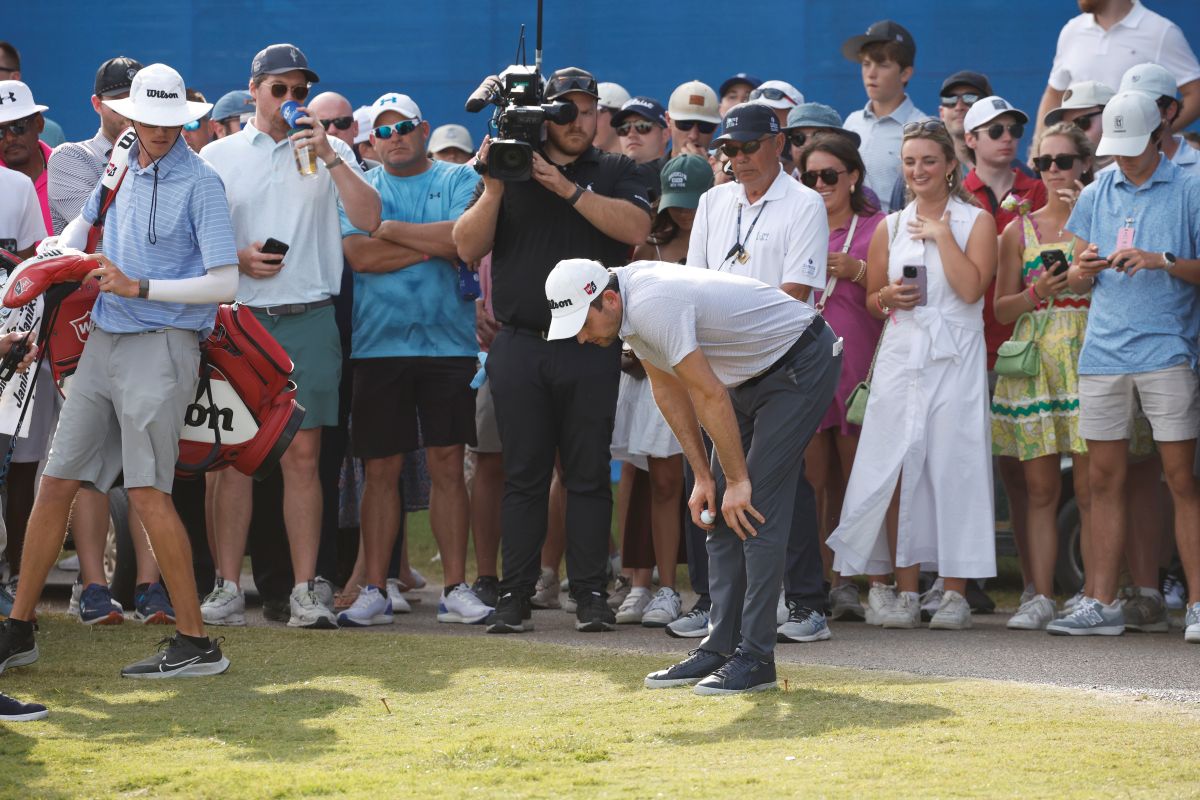









PGA Tour players don’t often retire. Not really. Not publicly.
Some keep playing forever, transitioning gracefully to the Champions tour, teeing it up for Charles Schwab points from South Dakota to South Florida until the end of time. Others play as long as they can, clinging to status even as it dwindles, dropping one ladder rung at a time until there’s no denying the fact that both feet have reached the ground.
But we don’t often get the sorts of farewell tours we see in other sports. We don’t get thank-you ads taken out in newspapers or teary, reflective press conferences — not unless you’re Jack Nicklaus or Arnold Palmer, when it finally happens in your mid-60s or mid-70s. So we often miss the perspective of life on the margins, the exit interviews of pros who have made it work for a while but eventually reach the end.
Enter Martin Trainer.
In some ways, Trainer’s career is strange and unique. For a while he had a Ricky Bobby-esque trajectory, either contending to win or missing the cut; he clambered onto the PGA Tour via multiple Korn Ferry Tour victories and then won in his first season, which locked up several more years of status.
But in other ways Trainer can speak to the typical pro’s Tour experience better than the guys we typically hear from, the Schefflers and Schauffeles and McIlroys and Morikawas of the world. He’s fought for status, he’s hopped tours, he’s waited around as an alternate, he’s Monday qualified and Q-Schooled and missed cut after cut and yes, he’s occasionally won.
Now he’s taking a unique post-PGA Tour path, prepping for psychology school as he mulls a career as a therapist. Pro golf, he says, gives you plenty of experience with pressure and stress.
Trainer shared 10 things he learned in an all-new retirement-announcement-turned-interview on the Drop Zone. Pieces of five are below.
1. There is (obviously) some really cool stuff about being a pro golfer.
People generally assume that playing the PGA Tour means you’re living the dream; the reality, if you’re not a top dog, is more complex. But yeah, Trainer confirmed with specifics: there is plenty of stuff that’s awesome.
“I think there’s those exhilarating moments that I can’t imagine you can experience outside of professional sports. It’s the moment where you make a long putt and the crowd cheers,” Trainer said. “It’s kind of a surreal, out-of-body experience. If you’re playing 17 at TPC Sawgrass, you’re hitting that tee shot and you hit it on the green, or let’s say you birdie that hole and the crowd goes wild. I think those are the peak experiences that are surreal and kind of hard to wrap your mind around.
“I don’t think it’s a very ‘natural’ experience to be put in that setting, but it’s certainly extremely thrilling. And I don’t think the rest of my life will ever include a moment like that ever again.”
But beyond the cheer, the career also provides a certain clarity of purpose. I thought there was something relatable and beautiful about the way Trainer described this bit:
“In terms of the lifestyle, I think what’s cool about playing professional golf is that you always have a goal. You always have a new week. You always have something that you’re working towards. I think in our modern lifestyle there are a lot of people that feel aimless, feel disjointed and divorced from community, and you have this sense of purpose, I think, with golf, where you really get to pursue your goal.
“It’s a craft. It’s a craft that feels important and meaningful. And I think that part really grounds you. It allows you to continuously look forward to something. And so it’s sort of psychological catnip. Because you always have next week, even if you bomb and miss the cut by seven shots, you always can just do a couple tweaks on the range and hope it goes better next week.”
2. Pro golf can be brutal, too.
“We just talked about the good parts. I think unfortunately there’s a lot of parts that are really challenging, especially from like a mental health standpoint,” Trainer said. “I think there’s something really unnatural, I guess, about flying every week to a new location, living in a hotel, never truly having a sense of community, never recognising your surroundings, never having a routine that involves the place that you’re in. … When you are in a new place, especially the first couple of years you’re out there, you’re trying to really savour it and enjoy it. But I remember my rookie year, I randomly joined up with Rory Sabbatini in a practice round. It was like, my third event. And I foolishly asked Rory, I was like, ‘Hey, how many times have you played this event? Do you usually play here? Have you played here before?’
And he just looks at me with a straight face and he’s like, ‘I’ve played here for 24 straight years.’
“And it’s like, at a certain point, maybe he did go to the fun little museum that they have at the centre of town, 22 years ago. And maybe you have your little restaurant that you go to. But the years add up and I think it’s harder as time goes on to get excited about those things.”
For Trainer, whose PGA Tour status eventually petered out, one rock-bottom stretch stands out — particularly one tournament that ended with a splash:
“I think there was one specific moment that I think was the lowest I’ve ever been,” he said. “It was a couple years ago at the 3M Open. So, relatively late in the season, I had a great first round. I shot like six under par or something like that. I was in second or third place after the first round. And I’d just missed a bunch of cuts, so I was like, ‘Oh, finally, I’m gonna have a big week. This is gonna be my week.’
“And the second round I just completely bombed. It was really windy, tough conditions, and I just kept making bogey after bogey. And it comes down to the last hole, and all I need to do is make par or bogey to make the cut.
“And I just like, flare my iron shot into the water and I make double bogey. And I was just so devastated. And that is something that I will not miss. That moment of just like, utter devastation, of some glimmer of hope that’s just snatched away from you is just really brutal.”
3. Pressure is very real.
Trainer described first-tee pressure as “an eight out of 10” but said that still pales in comparison to contention, where it climbs to “11, or more.” His best illustration of that phenomenon? Enter the 2024 Zurich Classic, where Trainer and his partner Chad Ramey ended up in a playoff against Rory McIlroy and Shane Lowry.
“I couldn’t feel the club, basically,” Trainer said. “And I just remember afterwards, I was like, I just had so little control over what I was doing. I mean, it was truly what they talk about where you can’t even think. Like, when you’re on the range, you can have a swing thought. Here there was no swing thought, there was just survival, you’re in fight or flight, and you just have to hit this ball, and it’s hard to simulate that. It’s hard to even imagine being in it. But you truly resort to like the most primitive form of like, hand-eye coordination at that point. You really can’t even attempt to control the club. You’re just going to swing. It’s just one mode. It’s swing.”
How’d it go for Trainer in the playoff?
“You know, mixed,” he said with a grin. “I mean, I hit a good drive, but then I had a really difficult pitch shot and I sort of flubbed it. And then I had to putt to tie the hole to move on to the next. It was about six feet and I just completely shoved it to the right. And I think it’s just hard to even control a club at that point, you’re just kind of hitting it.”
4. Celebrity is strange.
Trainer said he himself never reached anything close to celebrity status — “if I went to the grocery store or stepped outside of the golf course, no one knew who I was” — but his win at the 2019 Puerto Rico Open thrust him alongside fellow winners in top tee times and gave him proximity to the Tour’s biggest names.
“It truly is a curse in some sense,” he said. “I think regular people … everyone seems to dream about celebrity and social status and, you know, being recognised, but I struggle to find any positives in that. Just going to the grocery store or hopping on a flight and having people come up to you and say all sorts of weird, wacky stuff to you? It can’t be a fun experience. … I remember playing Pebble Beach with Jordan Spieth, and there was just one particularly obnoxious fan that kept yelling at him over and over again. And after a while, it’s like, you can’t just ignore it, you have to address it. And so he went over and kind of told him — this person was aggressively trying to get his autograph in the middle of play, and he politely told them to come ask after the round. But yeah, dealing with that, it would drive me crazy. I don’t know how those guys do it.”
5. The best course on Tour? They blend together — with one exception.
As a pro golfer, Trainer said, you’re generally far more concerned with the score you can shoot on a course than its history or architecture. But not always.
“You’re right that they all end up blurring together, but there are a few that are exceptional,” he said. “Number one, I think by far, is Pebble Beach. Like that was the only practice round that you look forward to all year.
“You assume that professional golfers love golf. Actually … a practice round, especially when you’re tired from travel or not in a good mood, can be a drag.
“But playing Pebble Beach was always a treat, practice round or not.”
This article originated on Golf.com











Leave a comment