









Do you believe in miracles?
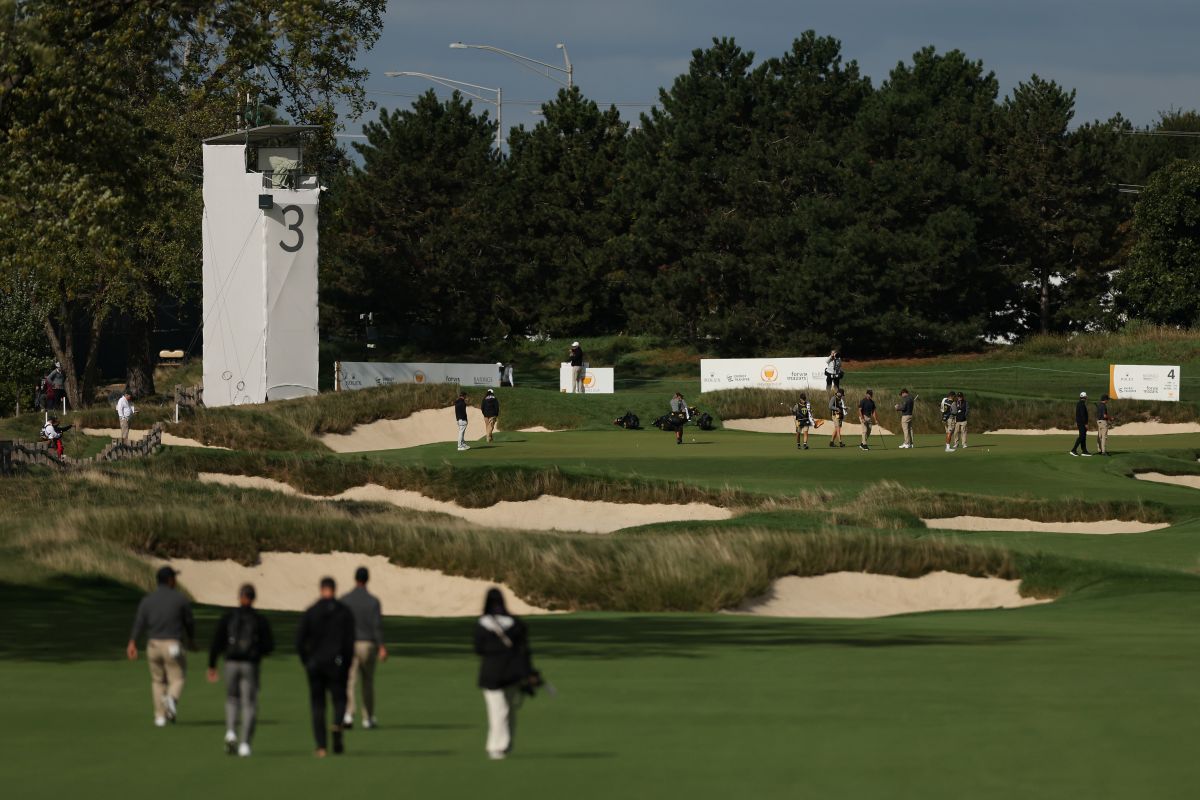
Justin Rose, Ian Poulter and their European teammates pulled one off with a stunning Sunday comeback at the 2012 Ryder Cup. Now, nearly a decade and a half later, must-watch match play is returning to the scene of that shocker, Medinah Country Club, outside Chicago. This time it’s the Presidents Cup, 12 Americans against 12 Internationals on the club’s No. 3 course. Given the historical record — the U.S. owns a lopsided 13-1-1 edge in this event — the Internationals will need some magic of their own. Here are seven things to know about the grounds where they’ll try to conjure it.
What’s in the name?
The club was founded in 1924 by a group of Shriners who belonged to the Medinah Temple in Chicago, which itself was named for the holy city of Medina in Saudi Arabia. The distinctive architecture of the clubhouse, replete with domes and minarets, reflects that Middle Eastern etymology.
It’s no stranger to big-time events
Medinah actually has three golf courses, but it’s No. 3 that’s done the heaviest tournament lifting: three U.S. Opens, a PGA Championship, a U.S. Senior Open, that unforgettable 2012 Ryder Cup, and now a Presidents Cup.
Sergio’s tree is gone. The memory of it isn’t
Even if you didn’t watch it live, odds are you’ve seen the shot in replay. In the final round of the 1999 PGA Championship, Sergio Garcia was tracking Tiger Woods when he left his drive behind a tree on the 16th hole. Instead of punching out, the prudent play, Garcia took a mighty swipe with a long iron, eyes nearly closed at impact and his left leg kicking wide. Somehow, he managed to find the green, a ball-flight he followed by chasing the shot down the fairway, hop-skipping as he went. Today, the tree is gone. It was removed during 2009 renovations. But Garcia’s feat lives on, memorialised by a plaque that marks the spot where he pulled it off.
Success has many fathers. No. 3 does, too.
Tom Bendelow laid out the original course when it opened in 1928, but in the decades since — and to varying degrees — other famous figures have touched up the design. A.W. Tillinghast took his turn in the 1930s, brought in partly to help the club survive the Depression by making the course sturdy enough to lure championship golf. Roger Packard retooled the layout in the 1980s ahead of the Senior Open and U.S. Open. Rees Jones did a full overhaul in the early 2000s for the PGA Championship. Most recently, Ogilvy, Cocking and Mead, or OCM, led a restoration aimed at nudging the course back toward its 1920s character. Among other alterations, OCM added bunkers (the total number increased from 70 to 117); expanded greens to create more pin locations; removed trees; built three new holes; and modified the routing so that the Lake Kadijah now figures more prominently in the closing stretch.
One of the captains tweaked the course
The O in OCM is Geoff Ogilvy. You know that name. He won the 2006 U.S. Open. He’s also captaining the International team, trying to engineer an upset on the course he helped remake.
This week’s routing is meant to ramp up drama
Altered by the OCM renovation, Medinah’s routing has been revised yet again for the Presidents Cup. The matches will begin on 5th hole, partly to ensure that the dramatic holes along Lake Kadijah figure in the competition (some 80 per cent of matches end by the 16th hole). The re-sequencing also makes logistical sense. It helps smooth spectator flow, which matters when Medinah is expecting Chicago-sports-venue-sized crowds all week.
Size only matters somewhat
No. 3 tips out at more than 7,600 yards. Which sounds like a lot, until you remember that distance alone does little to deter today’s best players. Consider, for instance, the layout’s longest hole (the 10th for members, it will play as the 6th in the Presidents Cup), a 646-yard par 5 that works downhill and downwind. Never mind the daunting yardage. The bigger hitters on both teams should have little trouble reaching it in two. That’s something to remember throughout the competition. Just as there are no pictures on the scorecard, the numbers written on it can be deceptive, too.
This article originated on Golf.com











Leave a comment