
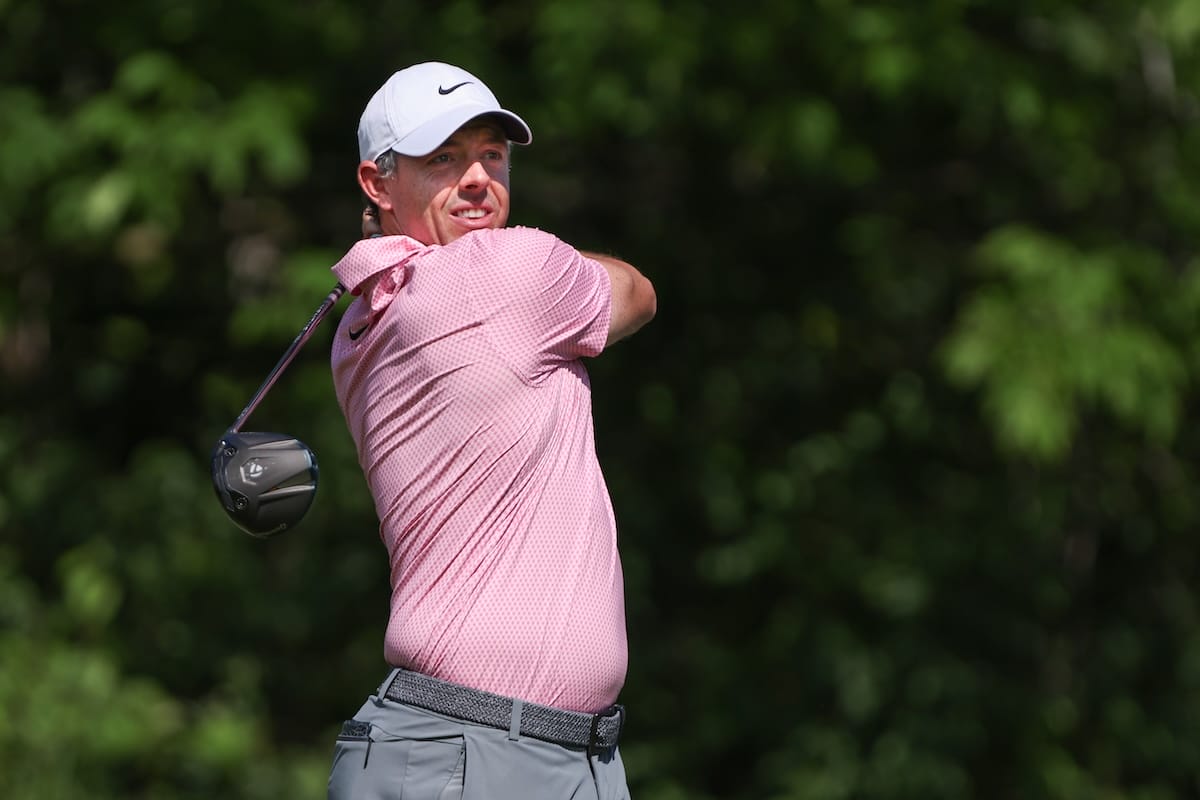









Though he finished tied for seventh and five shots back at the PGA Championship at Aronimink, the suggestion that Rory McIlroy could already be halfway to a history-making calendar grand slam is far from absurd.
Okay, the leaderboard was jam-packed going into Sunday, and with Jon Rahm, Xander Schauffele, Ludvig Åberg, Patrick Reed and several other big-name contenders among them, it was never going to simply be a case of hanging tough and allowing them to fall away one-by-one.
He was going to have to go out and put them to the sword, much in the way that eventual champion Aaron Rai did on the back nine, but he was in position to do exactly that. On position on the leaderboard, at least. It was the positions he put himself in off the tee that made it virtually impossible to follow through on the golf course.
In terms of accuracy, that week at Aronimink was his second-worst of the year to date off the tee. The actual worst? The Masters.
The big differences between winning one and being among the ‘close, but no cigar’ brigade in the other were the severity of the rough, and the difficulty of the pin placements, and married together, they made it virtually impossible to play attacking golf if you weren’t in the short grass.
Oddly enough, the Strokes Gained: Off The Tee figures – accuracy and distance combined – suggest that he drove it worse at the Pebble Beach Pro-Am, the Memorial Tournament, and the Dubai Invitational, but there lies the folly in Strokes Gained metrics because at Pebble Beach you could miss a fairway and have a reasonable expectation that your lie is good enough to still have a chance of getting it close even on the notoriously small greens. At Aronimink, you couldn’t.
By typical U.S. Open standards, the fairways at Shinnecock Hills are generously wide, and like Aronimink, though to an even greater extent, the penalty for missing them is severe. If you do, you’d better pray that you’re wild enough to be in the gallery or in a fairway bunker and far enough back from the lip to have a shot.
Depending on how creative the USGA wants to get with the pins – and here’s hoping they get very creative – then finding the bunker with the right angle could be much more favourable than finding the fairway with the wrong angle, but that’s a dangerous game because each of the fairway bunkers have the penal rough on one side or the other.
This is a rather roundabout way of suggesting that Rory is going to have to be much more accurate with his driver than he has been of late if he’s to have a realistic chance of claiming a second U.S. Open trophy.
After that, he only needs his distance control and accuracy on-point with his irons, to chip well when he inevitably misses the greens he does miss, and to hole more than his fair share of the five- and six-footers that will be plentiful if the USGA get the greens rolling at the sort of speed they’d like.
So, a simple task really!
The good news is that the Rory McIlroy who missed the cut at Shinnecock in 2018 and the Rory McIlroy who will return in 2026 are vastly different players.
In winning the Masters, his short game was his most deadly weapon; at the PGA, it was his putter. And on both occasions, he was better that field average when it came to approach play.
Put those stats on top of a man driving the ball the way he typically has throughout his career, and he’s not just the man to beat, he’s a man leaving a trail of dust behind him as he powers off into the sunset.
But it’s rarely that simple, and a lot less fun when it is. For the watching public, at least…
Rory’s driving issues date back more than 12 months. Ahead of the PGA Championship at Quail Hollow, McIlroy’s TaylorMade Qi10 driver head was ruled non-conforming due to natural thinning of the clubface, and though he had a supposedly identical replacement ready and waiting, whether it was literal or psychological differences, it wasn’t quite the same.
Not that he didn’t have success with it. See the Amgen Irish Open, the Ryder Cup, etc… But he was quick to move into the new Qi4D model that came out for 2026.
Statistically, he’s still hitting approximately the same number of fairways off the tee as he typically does, but the big difference has been where and when he’s been missing.
For a player who’s made par-5s his bread and butter throughout the years, he’s been forced to layup too often or to take on a much more difficult long-iron shot with little-to-no control over the spin.
That proved costly at Aronimink where he hit just two of the eight par-5 fairways he faced and played the holes in one-under for the week.
He’ll have just eight par-5s to tackle at Shinnecock as well, providing he makes the cut, and he’ll be counting on those to be his bread and butter again if he’s to find himself at the top or very close to it as we approach the back nine on Sunday.
You don’t win a U.S. Open, particularly not one at a course like Shinnecock, by being a one-trick pony, but when you’ve got a weapon in your arsenal that most of the other 155 players would kill for, if it’s not firing on all cylinders then you’re opening doors that you could be slamming shut.
But if he drives it like we all know he can, he’s almost halfway there.










Leave a comment