









If you were to summarise the 2020s for American team golf, your words probably wouldn’t be very friendly.
Well, unless you were a member of the team’s leadership, in which case your words to explain why the team has so frequently underwhelmed expectations might be a little too friendly.
E.g.: The conditions at Bethpage Black weren’t what the Americans expected … even though the team controlled the course setup. In Rome, a five-week layoff after the Tour Championship was too long for the team to stay sharp. And then there’s this one, also from Bethpage: Scottie Scheffler was sent out on the wrong set of holes in foursomes, forcing the World No. 1 to engineer a switch before his second alternate shot match of the weekend.
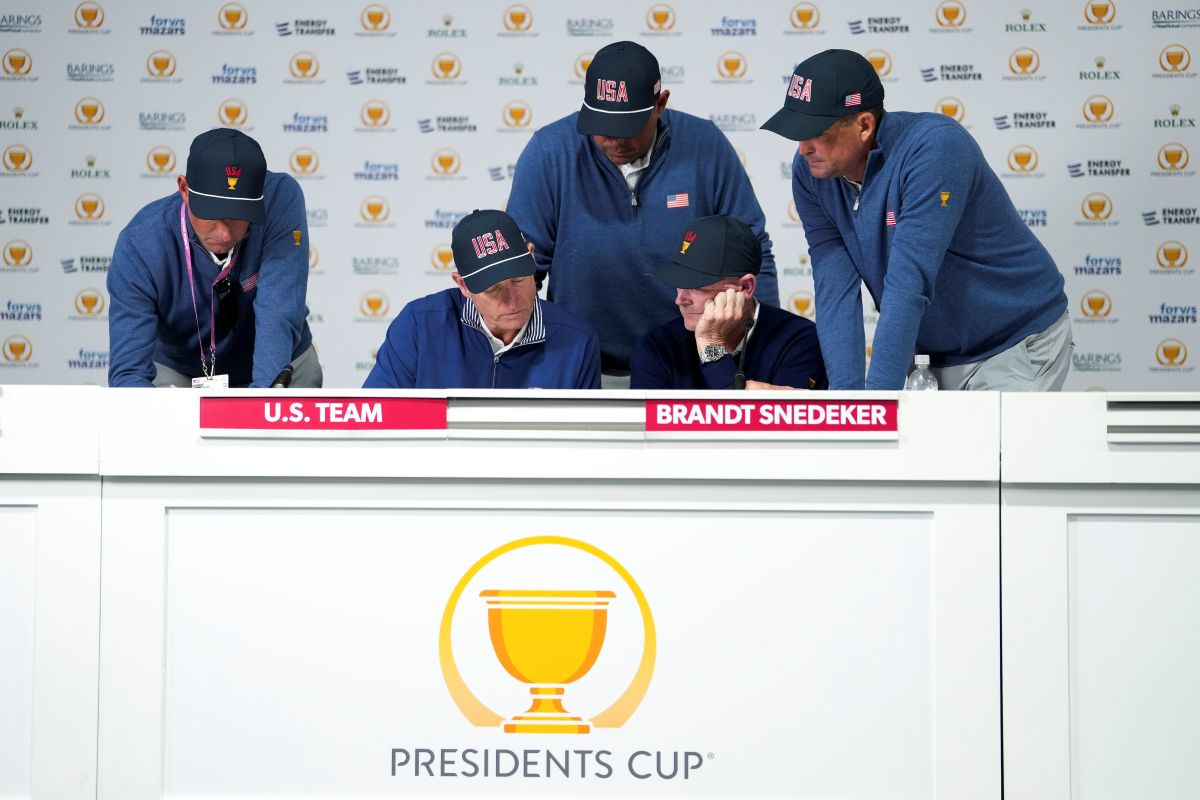
But if you know American team golf, you know that one excuse has proved stronger and more stubborn than all the rest — an excuse repeated by U.S. team captain Brandt Snedeker on the Golf Channel after Friday’s all-too-predictable trouncing in foursomes play in Chicago.
“They just made more putts.”
Of course, Snedeker is right. The Internationals made more putts in foursomes play at the Presidents Cup in ’26. Just like the Europeans made more putts in foursomes play at Bethpage in ’25 and Rome in ’23, and just like the Internationals made more putts in foursomes play at Montreal in ’24. If there is a reliable throughline involving the American performance in each of these team events, something you could set your watch to, it is that they make fewer putts than their opponents in alternate shot.
And here’s the pesky part of this excuse: the data backs it up. Over the last four team events, the Americans have made half as many birdies as their opponents in opening foursomes sessions (96 to 50); and nearly twice as many bogeys or worse (24 to 13). In those same foursomes matches, the Americans typically start missing putts early — they trailed in 15 of 18 matches after just six holes — and they keep missing ’em until the playing is done. (In those 18 opening foursomes matches, the Americans are 1-17.)
But what if I told you Snedeker’s diagnosis was part of the problem precisely because he was right? After all, you can’t fix something like making fewer putts. You can’t will your team to make more putts, just as you can’t convince your opponents to make fewer of them. You can train like hell at your putting, and you can get better over a large enough sample size, but you can’t know that a larger percentage of your putts fall during the one week of the year when it matters most, in the one competitive format where you tend to struggle most. You just have to get lucky. And American team golf? Well, they’re unlucky.
In the end, this kind of thinking may be the single greatest boogeyman in golf over the last half-decade. And why? Because the idea that something as important as the Ryder Cup rests on something as trivial as putting provides a wonderful justification to do absolutely nothing about it. It allows the people with the power to change something the freedom to choose not to. It encourages inaction at the highest level, and in the case of U.S. foursomes play over the last half-decade, inaction has looked a lot like, well, losing.
But there’s a problem with blaming America’s failures on making fewer putts: It ignores the fact that America has some agency in the putts it makes. And blaming those same failures on rotten luck ignores another fact — one that every single player, captain, caddie, support staffer and locker room attendant knows to be true: In golf, luck is something you make.
American team golf should know that luck is a bad excuse, and they should know it because of their opponents. The European and International teams have flourished in the 2020s (to admittedly different degrees) after overhauls to their organizational infrastructure aimed at increasing the likelihood of good luck during team competition. Under Ernie Els, Trevor Immelman and Geoff Ogilvy, the Internationals created an identity around the black-and-gold “shield” that encourages big thinking around pairings, preparation and continuity. Under Luke Donald, the Europeans have created a competitive machine. Beyond Donald’s unheralded three-peat as captain, Ryder Cup Europe has zoomed far ahead on analytics, organizes team practices for months to prepare potential partners, and obsesses over details as small as bedsheets and shampoo selection.
Think about this gulf next to the Americans, who, again, sent out their team’s most important player in the wrong order. The Americans aren’t just behind the Europeans — they’re fundamentally different from them. Even today, the two U.S. teams are operated by different governing bodies, led by different captains, and seem to revere the fact that they feature almost no formal overlap.
So, yes, the Americans could stand to learn a thing or two from what Ryder Cup Europe and the International Team have built, but golf isn’t the only place where lessons are hiding. If you look around the sports world, you’ll find an interesting lesson hiding in a most unusual place: track and field.
As it turns out, America’s recent case of bad luck in team play is not specific to golf. American sprinters have faced a similar issue in team events, particularly in the men’s 4×100 relay, where the U.S. has failed to medal in five straight Olympics despite regularly possessing the fastest group of individual sprinters in the world.
When the Americans fumbled the baton handoff and a medal in the men’s 4×100 at the Paris Olympics in 2024, U.S. Olympic legend Carl Lewis unloaded a scathing critique of the entire American sprinting apparatus that sounded … a lot like the critiques recently aimed at U.S. golf leadership.
“It is time to blow up the system. This continues to be completely unacceptable,” Lewis wrote on Twitter. “It is clear that EVERYONE at @usatf is more concerned with relationships than winning. No athlete should step on the track and run another relay until this program is changed from top to bottom.”
What’s different is what happened to USA Track and Field after. Rather than paying lip service to Lewis, USA Track and Field actually did blow everything up. In 2025, USATF announced a new program called “One Team”—an initiative aimed at completely revamping the organization’s approach to the relay, with several targeted fixes to improve team performance in the biggest moments.













Leave a comment