
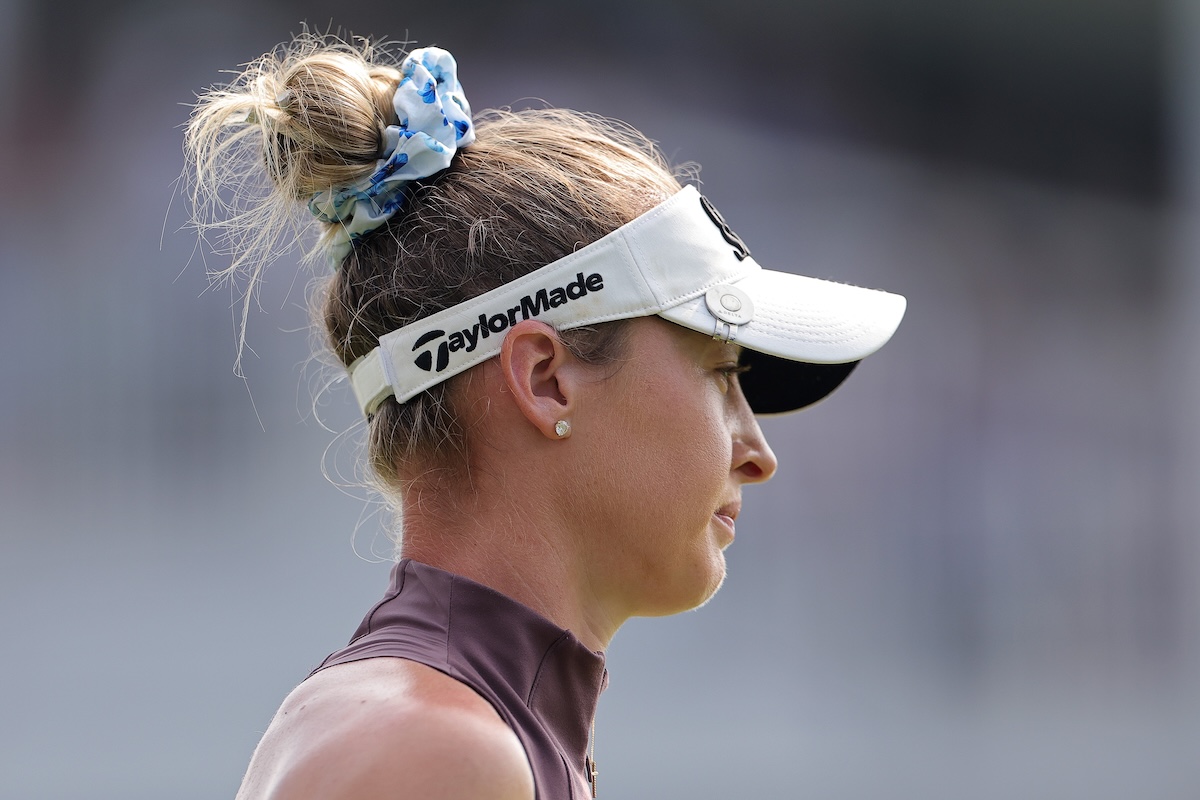









There were a record 29 different winners on the LPGA Tour last year showcasing not only the incredible diversity in the women’s game but the depth as well with winners coming from South Korea, Japan, Sweden, Thailand and the USA. On one hand, this is a brilliant display of the parity that other sports would love to have but without a dominant star it is difficult for the LPGA Tour to base themselves around a figurehead for new audiences.
Amazingly, Nelly Korda looked to be on her way to becoming the poster girl for the LPGA Tour. Seven wins including a major championship saw her end 2024 as world number one and undoubtedly the best player. Last year she had a winless season and lost her world number one ranking.
This season the 27-year-old looks back to her best. She won the Chevron Championship for her third major title and returned back to the summit of the women’s world rankings as she clinched her second win of the season.
Sport needs someone to aim for, to root against, to be the one to beat on every given week. Rory McIlroy might have something to say about this next statement but in the men’s game that player is still Scottie Scheffler. Korda has all the ingredients to become the female version of Scheffler – she was for that sensational spell in 2024 but she must find a way to sustain that.
In fact, there are similarities between the two players. Nelly has three major wins (2 at the same major), 17 Tour wins, 80 career top-10s and 19 career missed cuts. Scottie has four majors wins (2 at the same major), 20 tour wins, 81 career top-10s and 19 career missed cuts. Both are currently the world number one.
Women’s golf broadly speaking is in a good place. There is a significant Irish presence on both the LPGA and LET while the US collegiate system is starting to produce similar results to the men as in female players are coming out on tour ready to win – just look at Mimi Rhodes’ four LET wins last year in her rookie year.
Prize funds are continuing to increase on the LPGA Tour while the AIG Women’s Open at Royal Lytham & St Annes this year will feature a record $10m prize fund with upwards of 50,000 spectators expected to attend.
What a time for Nelly to potentially become the figurehead for the women’s game when it is reaching new audiences and generating record revenue. She has shown before that she can do Tiger-like things, and if she could reel off several majors in a double quick time stretch it would be brilliant for the game.
Also some rivalry at the top would go a long way towards helping give the women’s game a much needed bit of needle.
“For the women’s game, if they can get that rivalry perhaps between Nelly Korda, Jeeno Thitikul, Charley, that would be great for the game if they’re all vying for titles at the same time. But Nelly certainly has the game, and she has everything to be dominant,” said Catriona Matthew.
Not everything is rosey in the garden. Is five major championships too many? The Chevron Championship last week was the first major of the women’s season and Mimi Rhodes admitted that it felt very low key. She would have been forgiven for saying otherwise given it was her debut.
But the event was poorly attended and poorly promoted. Is that because there was nobody to hang it on? Perhaps the majors in the US just aren’t put on as much of a pedestal as the AIG Women’s Open is – the R&A must be commended in their promotion of the event.
Mark Darbon, Chief Executive of the R&A, was quick to point out that at the top of the women’s world rankings, the average age is 26 compared to 34 of the men while there are eight nationalities represented in the top-10 compared to just three in the men’s game.
Again, this is all great. Female players are now coming straight out of whatever youth system they were on and able to shoot for the stars. But longevity is not something associated with the women’s game. As of last year Stacy Lewis was one of two players on the LPGA Tour aged over 40 with talk of lowering the age limit for senior LPGA tour action from 45 to 40.
Paula Creamer (38), Natalie Gulbis (42), Brittany Lang (39), Christina Kim (41), Lincicome (39), to name a few were all big stars in their early 20’s but these tweenagers are no longer relevant at the top level.
A common trend sees players stepping away from full-time competition by age 30 to 33, as seen with Lydia Ko planning to retire at 30 and Amy Olson retiring around 30.
At 27, the window for dominance for Nelly is slim at best – if she was a male player she would be approaching her prime years. But maybe with modern technology, fitness and nutrition she can prolong her time at the top and eventually assert her dominance in Major championships.












Leave a comment