
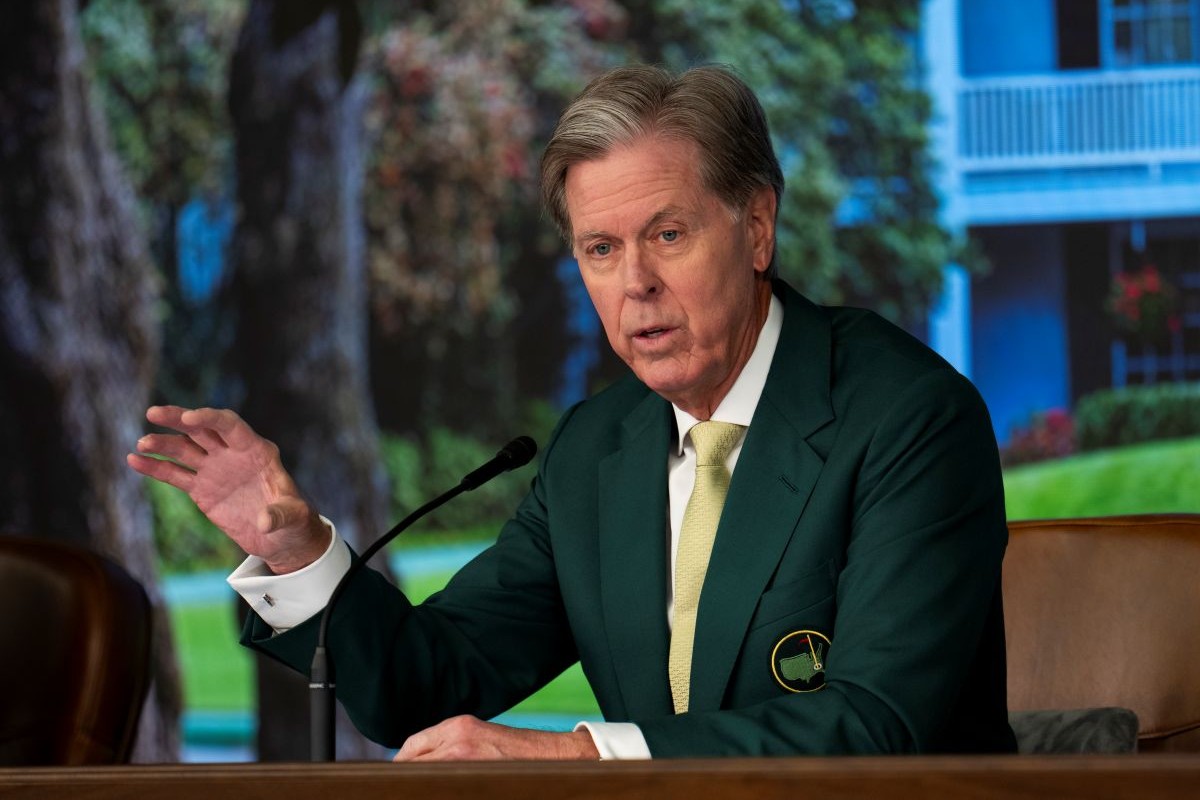









At his annual pre-Masters press conference, Augusta National Chairman Fred Ridley reaffirmed the club’s position supporting the USGA and R&A’s proposed golf ball rollback, currently slated for 2028 at the professional level, and suggested that the plans need to be finalised.
In January, the USGA issued a notice to manufacturers announcing that it was taking feedback on delaying the implementation of new Overall Distance Standard (ODS) tests until 2030, but that such a rollback would be adopted simultaneously across all levels, not in phases. The new test would require conforming golf balls to fly no farther than the current 317-yard limit, but at an increased clubhead speed of 125 mph from 120 mph.
Most estimates suggest the game’s longest players will lose 10-15 yards on their tee shots, while most recreational players will see negligible impacts.
“There’s always been quite a lot of agreement. My feeling on this subject is failure’s not an option. I think we need to continue to work together to come to some agreement,” Ridley said Wednesday morning. “What we’re trying to do is to protect the integrity of what makes golf so great. I think I tried to articulate it in my comments, and that’s that it’s more than about just hitting prodigious drives.”
Ridley said the club’s interest and position aren’t solely about protecting its own course, which has been lengthened significantly over the past 25 years to its current scorecard yardage of 7,565 yards.
The most recent notable change was the lengthening of the par-5 13th hole, arguably the most famous non-par-3 in the sport. In 2023, a new Masters tee was constructed, adding 35 yards to the hole for a new scorecard yardage of 545 yards.
To build the new tee, the club famously purchased land from the adjacent Augusta Country Club in 2017 and had a portion Chapman Court rerouted to accommodate the new tee.
Ridley said the change didn’t significantly alter the scoring on the hole, but that wasn’t the point. The goal was to restore Bobby Jones and Dr. Alister MacKenzie’s intent when they designed it over 100 years ago.
“What has changed is the way the hole is played today and, I think, the excitement of the hole. For example, before we added the yardage to 13, only about 60 percent of the field hit drivers. Now it’s 90 percent,” Ridley said. “The first year we added the distance, those same drives [that previously went through the fairway] stayed back in the fairway and allowed the player the decision — Bobby Jones called it a momentous decision — as to whether or not they wanted to go for the green. So we had players hitting 240-, 250-yard shots into the green, which I think is pretty exciting.
“So I think the hole is now playing more like it was designed to play. Sure, there are going to be some middle to even — probably not short irons, but there will be some middle irons played to that hole. But that’s not an easy shot in and of itself. But there are going to be more longer irons and even some fairway metals that are played. I think that’s the way we want the hole to play.”
But Ridley realises not every golf course, including many iconic venues, has the resources to make the changes Augusta National can and even Augusta can’t keep lengthening every hole. Ridley heard that firsthand this week.
“I talked to Jackson Herrington, one of our young amateurs, and he told me that yesterday he hit it over the bunker on 1 and 5, which is about a 325-yard carry, and one was into the wind,” Ridley said. “I’ve said that we can make changes, but there’s not much we can do to make changes, number one, unless we tear down the Eisenhower Cabin, and we’re not going to do that.”
Two years ago, Ridley claimed the Masters should never be played at an Augusta National course at 8,000 yards. At some point, even the seemingly endless resources of Augusta National will be limited to how long they can make the golf course.
Ridley wants the rest of the game’s stakeholders to take action before it’s too late. Talk of a rollback has been discussed for years without any concrete action taken until December 2023, when the USGA and R&A announced the proposed rollback, which is currently supposed to begin implementation in two years.
Even in the years since, as the proposed date has drawn closer, there has been growing doubt whether the proposal will actually be implemented.
“We’ll make changes when we can, but I think it’s time to really address this issue,” Ridley said. “It’s been talked about for a long time.”
This article originated on Golf.com













Leave a comment