









Change has been afoot at the PGA Tour: new investment; new leadership; new schedule and field sizes.
Next up: new rules. Six of them, effective immediately.
On Tuesday, the Tour shared with its players five new model local rules (plus one modification to its preferred-lies protocol) that it will institute beginning at the 2026 season opener, the Sony Open in Honolulu next week.
“Good, common-sense outcomes for the game at the highest level,” Steve Rintoul, the PGA Tour’s vice president, Rules & Officiating, told GOLF.com of the new MLRs, which were passed by the USGA and R&A on Jan. 1. “A continuation of what was established with the 2019 modernization of the Rules.”
Here’s what you need to know about each rule change, with context from Rintoul about why the Tour is implementing the tweaks.
Note: All the explanations in the “nitty-gritty” sections below are from the USGA and R&A’s “Additional Clarifications of the 2023 Rules of Golf,” which was last updated Jan. 1.
Rule Change: Player Has Not Played from Wrong Place When Unaware Ball Might Have Moved
In simple terms: If it is determined that a player moved his ball at address, but he didn’t know that he moved it, he will be penalized only one shot instead of two for not returning his ball to its original resting place.
The nitty-gritty: If a player causes their ball at rest to move and they fail to replace it before making their next stroke when they were neither aware that the ball had moved nor that it might have moved, the player gets one penalty stroke under Rule 9.4b (unless any of the exceptions under that Rule apply) but has not played from a wrong place if it subsequently becomes known that they caused the ball to move.
But when a player is aware their ball at rest might have moved and fails to replace it before making their next stroke, the player gets the general penalty for playing from a wrong place under Rule 14.7a if it subsequently becomes known that they caused the ball to move. The general penalty applies even if the ball was not replaced because the player incorrectly determined that it did not move or that they were not the cause.
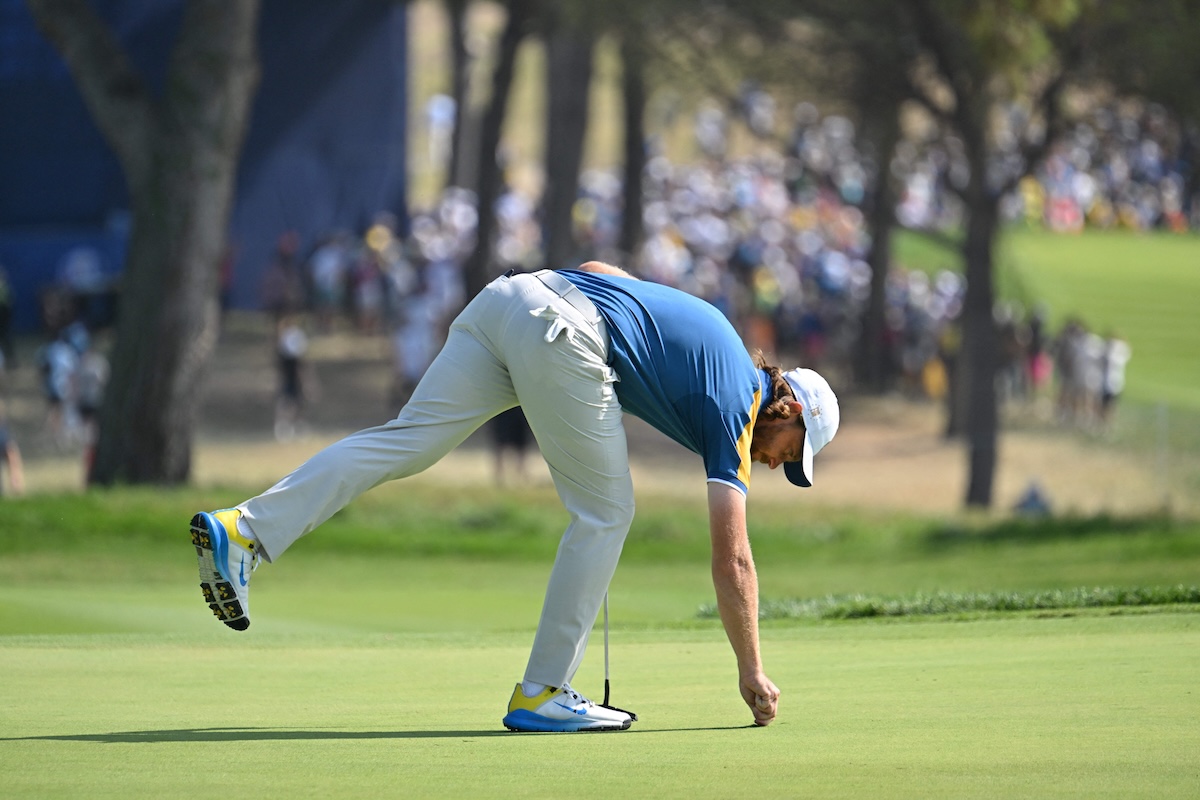
What drove the rule change: If this scenario rings a bell, that’s probably because it happened in a high-profile setting not long ago, at the 2025 Open Championship at Royal Portrush. That’s where Shane Lowry, in the second round, caused his ball to movefractionally with a practice swing on the 12th hole — but said he had no idea that he had done so.
After the round, officials showed Lowry a close-up replay of the moment, and, after a lengthy deliberation, slapped him with a two-stroke penalty. Lowry called the penalty “hard to take” but added, “If the ball moved and I caused it to move and it moved, it’s a two-shot penalty. The last thing I want to do is sit there and argue and not take the penalty and then get slaughtered all over social media tonight for being a cheat.”
Rintoul said that penalty — and others like it — didn’t feel right. “He’s getting penalized with two strokes for something he didn’t really even know he’d done,” Rintoul said. “So now it’s all based on what the player knew.”
But what if it appears from a replay that a player should have reasonably detected that a ball moved? In such an instance, could officials overrule a player’s word?
Rintoul said they could not. “This [rule] is all about a player who has no knowledge at all that he caused the ball to move,” Rintoul said. “He can’t be a clairvoyant.”
Rule Change: Limited or Extended Relief for Embedded Ball
In simple terms: If a player’s ball comes to rest in another player’s pitch mark, he may take free relief; previously, players were granted relief only if their balls settled in their own pitch marks.
The nitty-gritty: In addition to when relief is allowed under Rule 16.3a, if a referee determines that it is known or virtually certain that part of a player’s ball is below the level of the ground in a pitch-mark in the general area that is cut to fairway height or less that has not been repaired in some way and was made as a result of any player’s stroke, the player may take free relief using the procedures in Rule 16.3b.
A pitch-mark has been repaired in some way when it has been pressed down or undergone any form of repair by anyone whether deliberate or incidental, and regardless of the quality or completeness of the repair.
Examples of repaired in some way include when a pitch-mark has been pressed down with a club or foot, anyone has attempted to repair it with a tee or some other device, or when the pitch-mark is in an area over which a mower has passed or has been otherwise prepared by maintenance staff. A pitch-mark that has been repaired in some way can and will often result in a visible indentation from which there is no relief under this Local Rule.
What drove the rule change: We’ve seen this bit of misfortune unfold a few times in recent years. At the 2002 Players Championship, Paul Casey was in the hunt in the final round when his tee shot on the par-5 16th improbably settled into another player’s pitch mark; from that horrid lie, Casey was forced to lay up and he managed only a par, eventually finishing third. That same week, a Sam Burns tee shot also found another player’s pitch mark, on the 10th hole.
Then there was Shane Lowry (yes, again!) at the 2025 PGA Championship, where in the second round his tee shot on the short par-4 8th hole trundled into a pitch mark. After an official denied Lowry relief, Lowry chunked his approach and then took out his anger on the turf from which he’d just hit.
Rintoul said part of the motivation for wanting to amend this rule is that it’s been difficult to adjudicate. Determining whether a player’s ball has settled in his own pitch mark or another player’s, he said, can be a guessing game. “We’ve seen it time and time again,” Rintoul said. ”We’re getting this ruling wrong, players are getting this ruling wrong — it’s not a good look for the game.”
Rule Change: Internal Out of Bounds
In simple terms: Internal out of bounds will be designated as O.B. only for shots played from the teeing area.
The nitty-gritty: During play of [specify hole number], the [specify location or side] of the hole, defined by [insert description of method of defining out of bounds, for example, white stakes], is out of bounds for any stroke that must be made from the teeing area.
These are boundary objects during the play of [specify hole number] for any stroke that must be made from the teeing area. At all other times, they are [immovable | movable] obstructions.
What drove the rule change: PGA Tour players will look for any edge, including, say, playing down an opposing fairway to effectively make a hole shorter. To discourage such tactics and protect the integrity of its host sites, the Tour has, at times, installed internal O.B. zones. At Sony Open venue Waialae, for example, the Tour has employed internal O.B. on two different holes. Same goes for the 18th hole at the Players Championship, where, before 2021, some players would launch their tee shots over the lake to the 9th hole, which set up an easier angle into the green. The O.B.s curbed such sly shotmaking but created another problem.
“It actually handcuffed a player who was further down the hole, perhaps behind a tree,” Rintoul said. “You know, he tried to drive it down the fairway, got it stuck behind a tree and now he couldn’t even shift out sideways because he had this internal out of bounds in his way. The internal out of bounds wasn’t really installed for that guy. It was installed for guys that are standing on the tee trying to bomb it down this other fairway. So the governing bodies had given us an option where this internal out of bounds can still be applied. But it would apply only to tee shots for strokes made from the tee area.”
Rule Change: Immovable Obstructions Close to Putting Green
In simple terms: Players may be granted “extra relief” from the apron or fringe if an immovable obstruction — not just sprinkler heads — is in their line of play.
The nitty-gritty: When a ball lies anywhere other than on the putting green, an immovable obstruction on the player’s line of play is not, of itself, interference under Rule 16.1. Free relief is normally not allowed.
But if the aprons or fringes of putting greens are cut short enough that putting from off the green is likely to be a common choice of stroke, immovable obstructions that are close to the putting green may interfere with such strokes.
In that case, the Committee can choose to give an extra relief option under Rule 16.1 when a player’s ball lies in the general area and an immovable obstruction close to the putting green is on the player’s line of play.













Leave a comment