
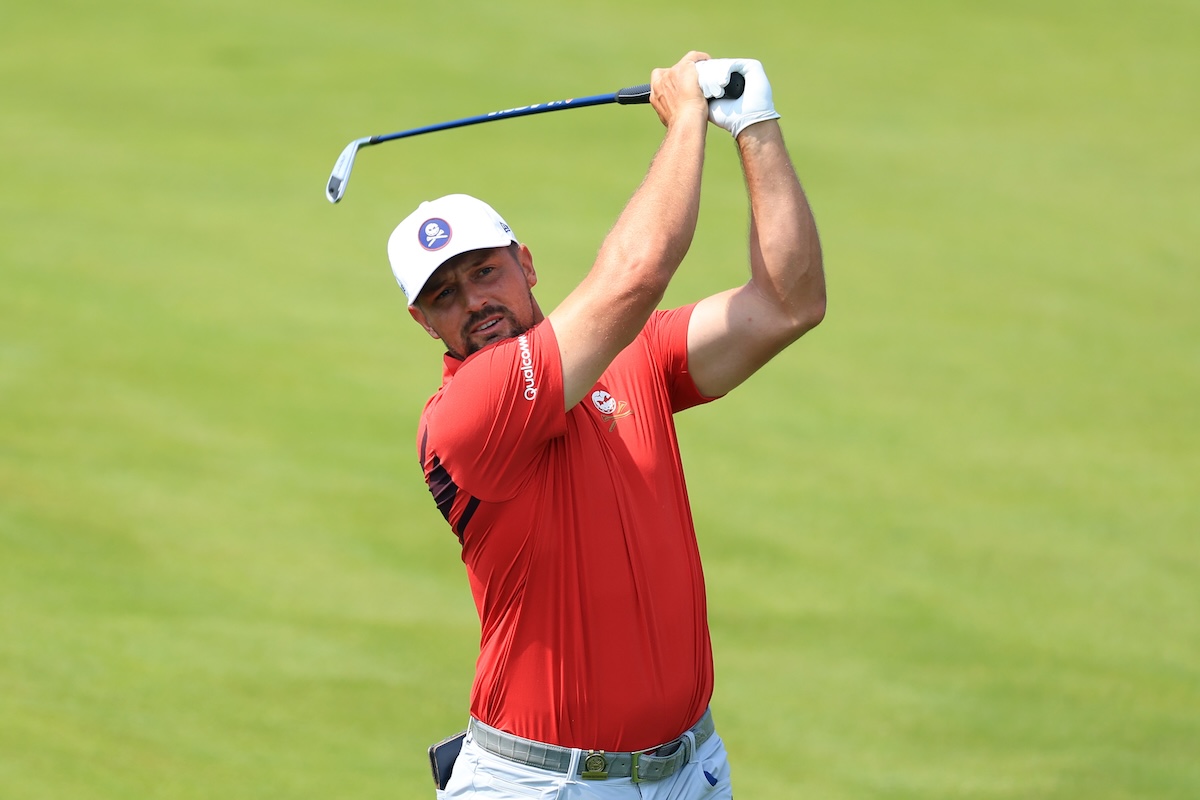








Last month, Bryson DeChambeau briefly stated the quiet part out loud.
As part of an interview with the social media account Flushing It, DeChambeau addressed his uncertain contract status with LIV Golf with a roundhouse kick.
“It’s where I want to be, but ultimately, it’s got to make sense for everybody,” DeChambeau said. “Because I could just do YouTube golf and be totally fine as well.”
Bryson’s comments came in the aftermath of the most significant piece of LIV Golf news of the 2025 offseason: Brooks Koepka’s announcement that he would be leaving the league to spend more time with his family, and perhaps to return to golf on the PGA Tour. The cause of Koepka’s departure from the league is not believed to be related to a contract dispute — according to several reports, the five-time major champ still had time remaining on his initial LIV deal — but it sparked a series of discussions about the contract status of the other LIV stars, DeChambeau chief among them.
The two-time U.S. Open winner is perhaps LIV’s biggest success story, a star player whose defection has coincided with a meteoric rise in his own popularity and public image. Of course, much of that growth is due to DeChambeau’s prolific exploits on YouTube, where he has gained 2.5 million subscribers (as of this writing) and has become the face of golf in new media — but LIV has also played a role, too, greasing the skids for the enigmatic pro to build his own platform and audience while still competing professionally.
“LIV gave me the economic viability to do these things — to be able to keep doing YouTube and growing YouTube,” DeChambeau said in early 2025.
But now, as the calendar flips to 2026, it might be said that DeChambeau has at least as much value to LIV as the other way around. From LIV’s perspective, DeChambeau’s superstardom and megaphone make him indispensable: He is a star player who moves the needle for a league that needs to move it. But from DeChambeau’s view, LIV might not be as necessary: The league’s money is valuable, but thanks to his exploits on YouTube, DeChambeau can have a platform, a voice and an income without LIV.
In other words, as DeChambeau put it to Flushing It, the price must be right.
But what is the price? Well, long before his next LIV contract was a source of palace intrigue, DeChambeau gave us a glimpse into the economics of his YouTube account via an early 2025 interview with the Joe Pompliano Show.
“What’s funny is, and I can say this, I’ve invested over $1 million in YouTube,” DeChambeau said. “Creating a company, and being able to effectively distribute the AdSense revenue and all this extra stuff, and it’s what I want to do, it’s what I care about.”
DeChambeau went on to say that he has hired “double-digit” employees to join his content creation apparatus, Regecy, which helps to ideate, produce and execute the social media ideas that wind up on his channel.
“Am I making money off it right now? I’m not,” DeChambeau said. “And that’s the cool part about it. I hope people can see that I’m doing this because there’s a genuine interest in growing the game of golf. I genuinely care, man. I genuinely care about growing the game.”
Does that mean DeChambeau’s YouTube exploits are losing him money? Well, not exactly. YouTube’s economics are based on a grand bargain: an ad revenue share between the platform and the creator. This means that for every dollar a YouTube video earns, YouTube takes roughly 45 cents and the creator roughly 55 cents. Revenue is paid out based on video performance, usually around $1-5 per thousand views. If we take the middle of those rates for DeChambeau’s videos, or $3 per thousand views, we can extrapolate that a one-off viral hit like Bryson’s Break 50 video with Stephen Curry has earned him more than $20,500 (and counting).
But the good thing about YouTube content? It compounds over time. Well-executed viral videos continue to accumulate views, which means they continue to make money. So if Bryson’s account continued to generate in the neighborhood of 20 million views per month across all of his videos, as it did in 2024, and if those videos each earned a rate of $3 per thousand views, then Bryson’s account would have earned a hefty chunk of change at the end of the year — perhaps as much as $800,000.
And that’s before any of the other moneymaking levers pulled by famous YouTube stars every day — strategies like brand partnerships and targeted ads and in-video promotions that can amount to hundreds of thousands, if not millions, for stars of DeChambeau’s 2.5 million-subscriber ilk. (And yes, that’s not counting the role DeChambeau’s fame as a tournament golfer plays in sponsor discussions — though it can be assumed that it helps DeChambeau’s bottom line.) In other words, it isn’t hard to see a world where DeChambeau’s status as a YouTube megacelebrity (and golfing superstar) helps launch a content business worth close to the $45 million valuation raised by Good Good Golf in March 2025.
What that all means for LIV’s negotiations with DeChambeau isn’t yet clear. Perhaps DeChambeau was merely exercising his god-given right to leverage when he threatened to leave LIV for YouTube, at which point his threats read more like an effort to add a handful of extra zeroes to his next Crushers contract. But perhaps DeChambeau wasn’t kidding about becoming a full-time YouTube golfer — and a part-time tournament player — should LIV’s final offer not meet his needs. That would read as one of the most astonishing developments in this strange period in pro golf, even by DeChambeau’s own maverick standards.
Could a player of DeChambeau’s stardom plausibly leave professional golf for YouTube? It’s too soon to say. But it seems clear the next Bryson DeChambeau LIV negotiation will center around a first-of-its-kind binary in the golf world: either a very big Golden Ticket … or the whole damn chocolate factory.
This article originated on Golf.com











Leave a comment