
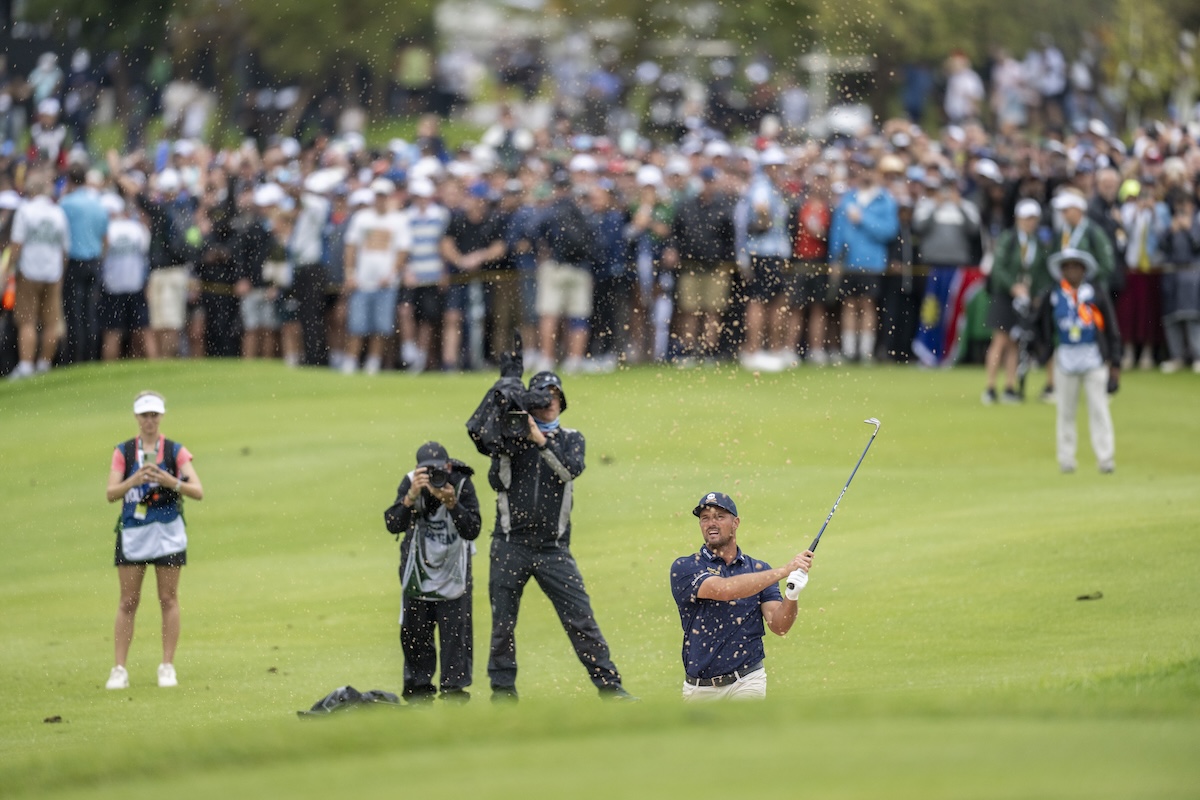


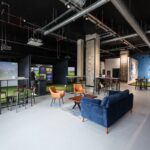




Bryson DeChambeau looked exhausted, leaning on the edge of a desk in the LIV Golf media centre Thursday afternoon. His chin sagged as he exhaled, only raising for a sip from his grape-flavoured Celsius energy drink.
“It’s been a long couple weeks,” he said, referring to LIV’s trio of consecutive March stops: Hong Kong to Singapore to South Africa. “But this is what LIV is supposed to be.”
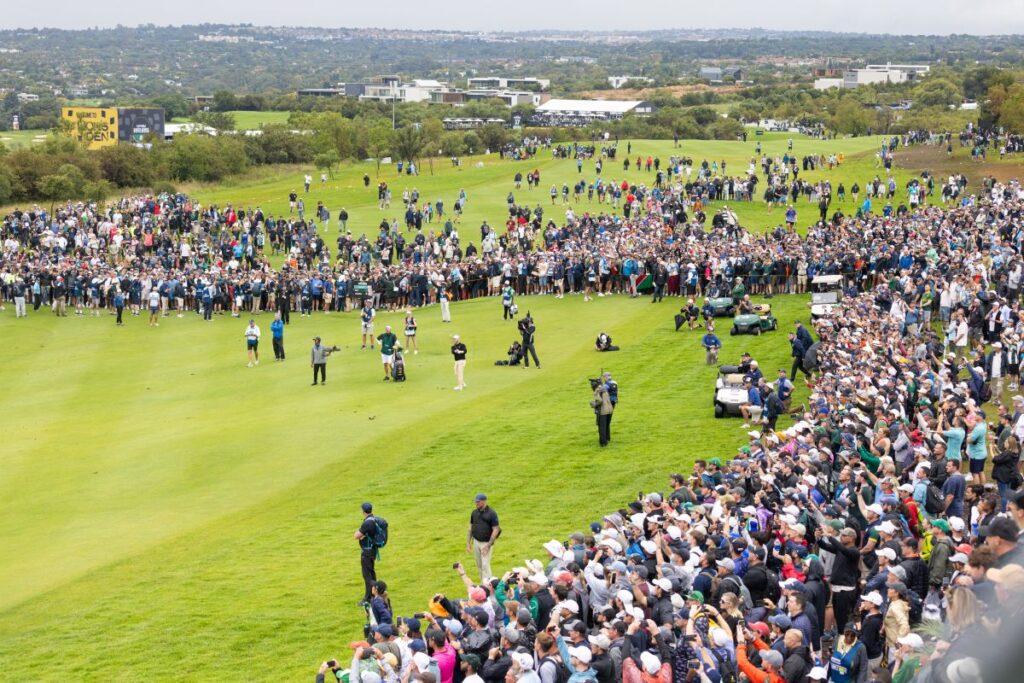
DeChambeau looked out through the floor-to-ceiling windows of the media centre at a golf course buzzing, spectators moving in every direction. The first round had just ended and he held a share of the lead.
“It might not work everywhere,” he said, “but in certain spots, it absolutely can.”
That sentiment is the theme of the moment for LIV Golf as it leaves behind its fifth event of the year, in South Africa. Fourteen months ago, when Scott O’Neil took the helm from Greg Norman, the league was not ready for the African continent. But shortly after O’Neil arrived, Louis Oosthuizen convinced South Africa’s minister of sports, art and culture, Gayton McKenzie, to attend LIV’s Korea event to better understand the league. McKenzie met DeChambeau that week and quickly became enamoured with LIV’s offerings. He is a boisterous man, unshy about his desires to bring big sport to his country and so keen to do so that he did a handshake deal with O’Neil on that Korea trip. Ten months later, LIV South Africa became one of the most successful events in the league’s four-year history.
The reasons behind that success, as ever, require context. How LIV creates its events is, now more than ever, plainly obvious, as if spelled out on a chalkboard at LIV HQ, or in the application the league requires municipalities to fill out. If a location checks enough boxes, LIV is likely to bring an event there. If it doesn’t check enough boxes, like, for example, receiving government funding, LIV is likely to look elsewhere.
“Adelaide is the template,” LIV pro Brendan Steele told me on the range last week. He was giddy. There was anticipation in the air, with digital clocks ticking down everywhere you looked ahead of the first round. By Adelaide, Steele means Australia, but more specifically, the state of South Australia, which welcomed LIV years ago and has been hosting its most successful event ever since. That it coincided this year with an out-of-nowhere win by Anthony Kim was gravy.
Steele and I chatted only briefly, but he said great LIV events don’t necessarily need to “check all those boxes.” That feels optimistic, especially when it comes to LIV’s desire for government funding.
South Australia has signed on as LIV’s Australian home through 2031. New Orleans is getting its first LIV event this year, but only after earmarking $7 million to make it happen, from the same budget that offers public funding to host the Super Bowl and other major sporting events. LIV went to Chicago in each of its first four seasons — no other city could say that — but is not this summer, because sufficient state funding never materialised. If the Chicago Bears are going to struggle to get Illinois state money, to the point of considering a move to northwest Indiana, LIV Golf likely will, too. (Perhaps unsurprisingly, LIV has found a new Midwest home in Indianapolis.)
For LIV South Africa to become a reality, getting McKenzie to pursue government aid was step 1 — and McKenzie, who was out and about at the Club at Steyn City all week long, was the right man for the job. He so badly wants F1 to reroute its globe-trotting schedule through his country that he spoke up when multiple races were cancelled recently in the war-torn Middle East. In hopes of landing an F1 race in the future, he recently promised to make an offer the racing circuit couldn’t refuse. He’ll now have a golfy case study to include in his proposal.
It’s unclear what amount of public funding LIV Golf’s Joburg event landed, but it clearly led to a massive success. On Sunday morning, LIV announced it would return to South Africa next April, with McKenzie essentially opening the ticket window himself.
“LIV Golf is never leaving this continent again,” he said. “Which means we’re going to be here 2027, 2028, 2029, 20-forever. We’re going to be here.”
——–
AFTER THE SECOND ROUND, DeChambeau is back in the media centre, sipping another Celsius, panting less heavily this time.
“Be honest,” he starts, “how many PGA Tour events are like that?”
He’s referring to the sound, the fervour, the hanging-around-well-after-the-round element that happens when the golf is a lead-in to a performance by one of South Africa’s biggest DJs, Black Coffee. Between Friday and Saturday, event organisers had to replace the white picket fence surrounding the party hole with a metal one out of fear that the crowd would trample it.
“Not many,” I say. “But be honest, at how many places can this actually happen?”
“Five or six internationally,” DeChambeau says, indicating he’s given the idea thought. He rattles off Australia, South Africa, Spain and England, maybe one in Asia.
“And definitely one in Chile, for Torque [GC].”
The globalist mind wanders. Santiago … Buenos Aires … DeChambeau was not the only LIV contractor to suggest this number of roughly six locations worldwide that could host the raucousness of 100,000 people who want a festival concoction that pairs golf with music, arts, food, etc. That is the LIV product now more than ever. It’s impossible to know how many attendees are treating the golf as an opener for Calvin Harris, or how many view Harris as a dessert following DeChambeau, but LIV sees either scenario as a market advantage.
South Africa is not necessarily starved for pro golf. The DP World Tour has played host to four tournaments in the country in the last four months alone. But what the DPWT brings to South Africa is so different from LIV that it’s almost offensive to each league to compare the two. The DPWT isn’t trying to create festivals. LIV isn’t trying to do anything but make a massive, memorable splash. All of which made event organisers, in the planning stages, think far more about the 2003 Presidents Cup — held in South Africa — than any Nedbank Challenges. Last week’s event was endlessly hailed as the biggest golf event in South African history, just like the Adelaide event in February was similarly dubbed for Australia.
The architect of these events is Ross Hallett, who brings decades of golf-event experience from IMG. He wants every LIV event to be as big in scale as the Presidents Cup, but while feeling less like a traditional golf tournament. “Music works,” he says. “We know it. Easy. How do you incorporate art? We haven’t got it [figured out], but there’s [local] art on every TV tower.”
In Hong Kong, local celebrity chefs were cooking in the fan village all week, with mirrors placed above their heads so spectators could better see.
“They were mic’d up and I was like, This is awesome ,” said O’Neil, LIV’s CEO. “Now, is it for everyone? No. Does it move the needle in selling more tickets? I don’t know. Maybe, maybe it doesn’t. But like the whole total experience. It’s like that fully cultural experience, which I love, and I think over time that wins because it’s right in the demo. It’s right in the demo: culture, food, art, music, golf.”
That O’Neil referenced golf last among those attractions might well have been unintentional but it does raise a question: Can the golf at LIV Golf matter…
This article was written by Sean Zak and originated on Golf.com












Leave a comment