
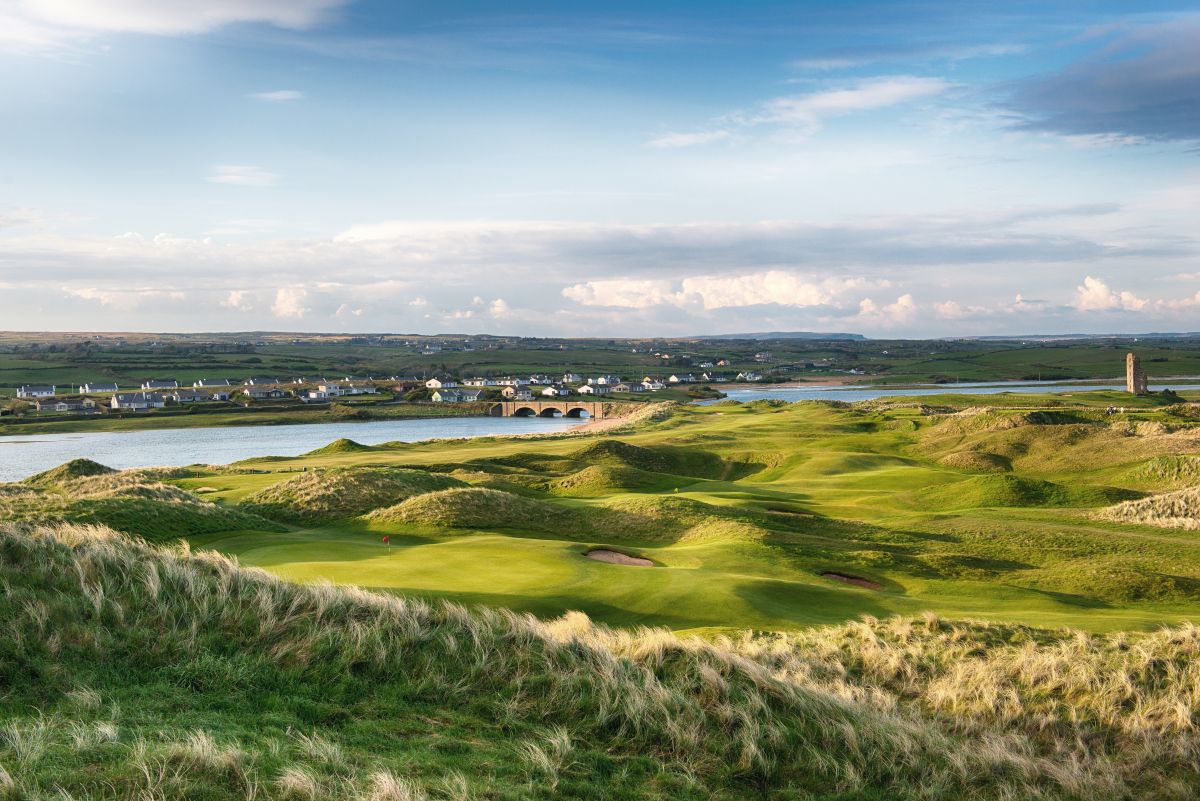









With the Walker Cup at Lahinch, the Arnold Palmer Cup at Tralee, the Jacques Léglisé at The Island, and the European Women’s Team Championships among the marquee International events which will be held on Irish soil in 2026, Rónán MacNamara talks to Golf Ireland’s Mark Wehrly and finds how our own National Championships are continuing to punch above their weight and why the international spotlight will only make them stronger in the year ahead.
In 2025, 11 Irish Championship events were ranked inside the top 90 in Europe for World Amateur Golf Ranking (WAGR) points, and those 11 events featured in the top 25 across the UK and Ireland.
With Lahinch set to host the 51st Walker Cup in September and the South of Ireland just seven weeks earlier, the South could be the strongest WAGR event this side of the Atlantic, with a strong presence from both the GB&I and USA Walker Cup squads anticipated.
The 2026 Irish championship season is set to be a blockbuster year on both the men’s and women’s sides, with the Jacques Léglisé, European Women’s Team Championships, Palmer Cup, and the Men’s and Women’s Home Internationals also coming to Ireland.
Date changes to the North of Ireland and the Irish Women’s Amateur Open, as well as new provincial events added to the women’s calendar, look set to cause a stir for the better as Golf Ireland tries to keep its championships at the top of the amateur pyramid.
The South of Ireland has been lacking in quality depth of field in recent years, but there is no doubt that every Irish player will be looking to take part in what should be a box-office occasion.
“It’s inevitable that it’s going to be a fantastic championship. We have heard that there will be a considerable presence from Walker Cup squads, which will be phenomenal,” says Mark Wehrly, Championships & Rules Director at Golf Ireland.
“The South will be a matter of weeks before the Walker Cup. It is very unusual for a major event like the Walker Cup to be held so close to a domestic championship in a country. Normally they don’t allow it, but we made a convincing case which has led them to make an exception.
“I am really excited about the field we could get. There is potential to see one or two American players in the field. We will be engaging with the USGA in relation to it, and Lahinch is extremely proactive in those conversations.”
Golf Ireland has certainly made the most of international amateur events on the island, with both the men’s and women’s amateur championships coming to Ireland in 2024. The Jacques Léglisé Trophy will be played on the island in 2026, which will see plenty of the top male junior golfers teeing it up at the Irish Amateur Open at Seapoint in preparation.
“We also have the Jacques Léglisé Trophy on the island next year,” Wehrly continues. “The captain is from Ireland, so they could have the entire squad playing in the Irish Men’s Amateur Open. We will use those events to leverage the best fields we possibly can from them.
“There’s a lot of international golf now, so we do need to be very proactive to make the most of those things.”
The top male juniors graced County Louth Golf Club at last year’s R&A Boys Amateur Championship, and they will do so again for the Jacques Léglisé.
However, the 2025 Golf Ireland championship season demonstrated that Ireland has some talented youngsters coming through in both the men’s and women’s game.
In fact, breakout stars and first-time winners could be a common theme in the coming years, with the transition from boys’ and girls’ golf to men’s and women’s golf appearing to be smooth for some of our best.
John Doyle and Dylan Holmes clinched men’s titles at the Munster Strokeplay and the West of Ireland, while Irish Women’s Open winner Louise Landgraf of France joined Doyle on the Junior Ryder Cup team in September.
Ireland has a great mix of experience and youth in its championships, particularly at men’s level, as youngsters Gavin Tiernan, Thomas Higgins, and Doyle joined those over 30, Stuart Grehan, Matt McClean, and Caolan Rafferty, at the European Team Championships in Killarney.
Indeed, in the last 15 years, the average age of championship fields has fallen from 28–29 to 23–24.
“It’s probably the first time I have seen this trend to that extent since the likes of Rory McIlroy and Shane Lowry were on the scene, and, to some degree, Tom McKibbin. The age profile of championship golf is getting younger,” explains Wehrly, who made championship appearances during his amateur career.
“The great strength of Irish championship golf is that we have such a large number of career amateurs who are at the top of the game to provide competition for those youngsters. What Caolan did this year is practically impossible to imagine in other countries. We have Colm Campbell, Stuart Grehan, Matt McClean who provide great competition and a wealth of experience so when the likes of Dylan Holmes, John Doyle, Gavin Tiernan or whoever else is coming through the ranks are challenging them.
“They know that beating these guys is a considerable achievement because they have been there and done it. It shows how strong our championships are that we have that blend. On the European team this year we had three players over 30 as well as three young players; there was no other country that had that.
“We’ve always had very young players competing and doing very well, and winning in certain cases, in women’s championships and that’s becoming more common now in the men’s championships. Boys are finding the transition easier to men’s golf and that’s down to the high-performance approach in giving them opportunities when they are younger.
“We are seeing the development of a mid-amateur cohort among the women which would never have been the case in the past. Aideen Walsh, Clodagh Coughlan, Shannon Burke and Jessica Ross are competing and doing really well domestically and internationally.
“We are getting towards that sweet spot in the men’s and women’s game in having strong representation of experience and youth.”
There are always challenges when organising championships. One argument that has been raised with Golf Ireland is that the strength of field isn’t what it used to be.
For argument’s sake, the deadline for entry to the Men’s Irish Close was repeatedly extended and ultimately the field wasn’t entirely full. Despite history being made by Caolan Rafferty’s provincial slam at the North of Ireland in September, it was fitting that he won it in near darkness.
With light fading it represented a championship that was on its knees. A poor-quality field, little promotion and only a handful of people on site to witness a historic moment make it clear that a move to a May date for 2026 was needed to breathe new life into the event.
On the women’s side there were several high-profile withdrawals with our top female amateurs swerving events which was disappointing to see.
The World Amateur Golf Ranking (WAGR) has presented its own challenges with points heavily skewed towards US collegiate events which, again, may prevent our best players from playing in our own championships.
However, as a package, Golf Ireland championships still stand at the top of the amateur game. In the 2023 and 2024 seasons Irish championships had the highest average WAGR points per event of any country in Europe and, as stated already, Irish championships were ranked high against Europe and the UK in 2025.
So, despite some clear challenges that need to be addressed, Golf Ireland championships are in a good place.
“WAGR is foremost in our thoughts in the men’s and women’s game,” adds Wehrly. “It is hard to say what the impact of WAGR is. If you got rid of it tomorrow, I think very little would change. What WAGR has done is it has allowed us to benchmark our events against other countries.
“WAGR is quite skewed towards US collegiate events, and this is a point of concern that we have raised with the R&A through the EGA and they are reviewing WAGR. If you leave those aside it is a very good tool to benchmark us against other European countries.
“We are doing quite well.”
Wehrly feels that between the provincial and national championships in Ireland, the structure of our amateur season is as good as there is in Europe.
Golf Ireland regularly attract player feedback in terms of scheduling, format and location for their events in order to keep everyone as happy as possible, while they will also keep supporting their players and squads in international tournaments which is vital for player development.
“While there might be higher-ranked events in other countries, if you take our events as a package, there isn’t a better package in Europe, and it means that we might not get all the best players at all of the events, but we have a very strong offering in all of those championships.
“We always try to see if we can improve things and take those opportunities if we get them. Most of our championships are weekend-orientated with the North and South being exceptions. We talk to the players first and foremost to understand what their priorities are.
“It’s really difficult to compare the Irish Close now to what it was 20–30 years ago because there are additional pull factors for players to play international events a lot more and we support those who want to.
“If we stopped supporting them playing abroad and tried to compel them to play more domestically, we might strengthen our own fields but it could be to the detriment of our players particularly if they are trying to make Walker Cup, St Andrews Trophy teams. Even to strengthen our own prospects of playing in European Team Championships they need to be playing internationally; it’s just not tenable to field a team of six players who have only played golf competitively in Ireland.
“We continually make changes and tweaks to try and get better fields but that is the challenge we are working within when we do it.”
Format changes have been commonplace in Golf Ireland Championships. Particular highlights have been the Irish Men’s Close and the North of Ireland switching from matchplay to strokeplay in recent years.
The elite players prefer strokeplay as it identifies the best player on any given week while many golf fans feel it best prepares our aspiring professionals for the professional game.
But there will always be a place for matchplay, and you just can’t beat the thrill of the 64th man beating the leading qualifier in the West or South.
“We do tracking surveys of all championship golfers to benchmark how we are doing on pace of play, course set-up, scheduling and format of events. We keep very good data,” explains Wehrly.
“Strokeplay has become more popular. Elite players prefer it as it identifies the best player. Amateurs with full-time jobs like the certainty it brings in terms of scheduling, booking accommodation. It’s a huge challenge to book accommodation for events that have a significant matchplay component; players are wondering whether they are going to be around for the next day.
“I think having two really good matchplay events in the South and West, falling at the times that they do, is about right and the clubs that partner with us are really keen on retaining the matchplay as well which is important.”
The World Handicap System (WHS) has also proven to be a challenge for Golf Ireland. Since the WHS was introduced into Ireland we saw the handicap cut for championships nosedive dramatically into the plus figures.
Many players were disgruntled by this, particularly since there was heavy manipulation of the general play scoring format for handicap purposes.
Essentially, players were basing their handicap primarily on general play scores to lower their handicap accordingly to qualify for championship entry. This not only left some championship regulars on the outside looking in but caused great embarrassment for players who used this loophole as their strokeplay scores clearly indicated that they were not ready to compete at this level.
Wehrly and his team acted to end this problem and in 2023 introduced a ruling that stated a player could not have more than four general play scores in their counting scores for their handicap if they wanted to enter championships.
Following a lengthy international review in parallel with recommendations from the WHS Handicap Operations Committee, it was decided that in the event that an entrant has more than four General Play scores on their record (in their last 20) and where their General Play scores are significantly better than those in competition (i.e., more than two shots better on average) their entry will be reviewed by the Championship Committee.
Wehrly insisted at the time that this was not about exclusion but rather to ensure that those who should be competing in Ireland’s elite championships receive every chance to do so.
Championship fields saw a dramatic change upon the introduction of the rule.
“When we did it in 2023, it had a very material impact on championship fields,” Wehrly continues. “In most championships the composition of the fields changed by 15–20%. That meant that those who would have otherwise got in did not because of the new rule and there was a flag placed on their handicap for general play scores that they had and how it influenced their handicap.
“In 2025 there was minimal impact so very few players are getting flagged now which would not have been the case three years ago. So, it is working and players are more aware now of what they need to do to qualify for championships and demonstrating their ability to play in competition is a key component of that.
“We won’t allow a situation where somebody’s handicap is overly dependent on general play to get into a championship. Some players who were getting into championships just weren’t ready.”
Golf Ireland recently published their 2026 schedule which sees the Flogas Irish Men’s Amateur Open Championship retained at Seapoint. The Irish Men’s Close heads to Portumna, the North returns to Royal Portrush and is moved to a May date.
On the women’s side the Flogas Irish Women’s Close is back to a May date and will be held in Newlands while a new provincial championship, the East, will be staged in Woodbrook. This is part of a new initiative that will be part of a series of exciting changes to the women’s domestic championship programme to be announced in the coming weeks.
Golf Ireland are always looking ahead and are already putting plans in place for the 2028 domestic season.
“We are currently looking at 2028; for various logistical reasons we need to be three or four years ahead. We have an annual meeting with the R&A and the EGA in relation to fixtures which is important to ensure we don’t have major events clashing.”













Leave a comment