
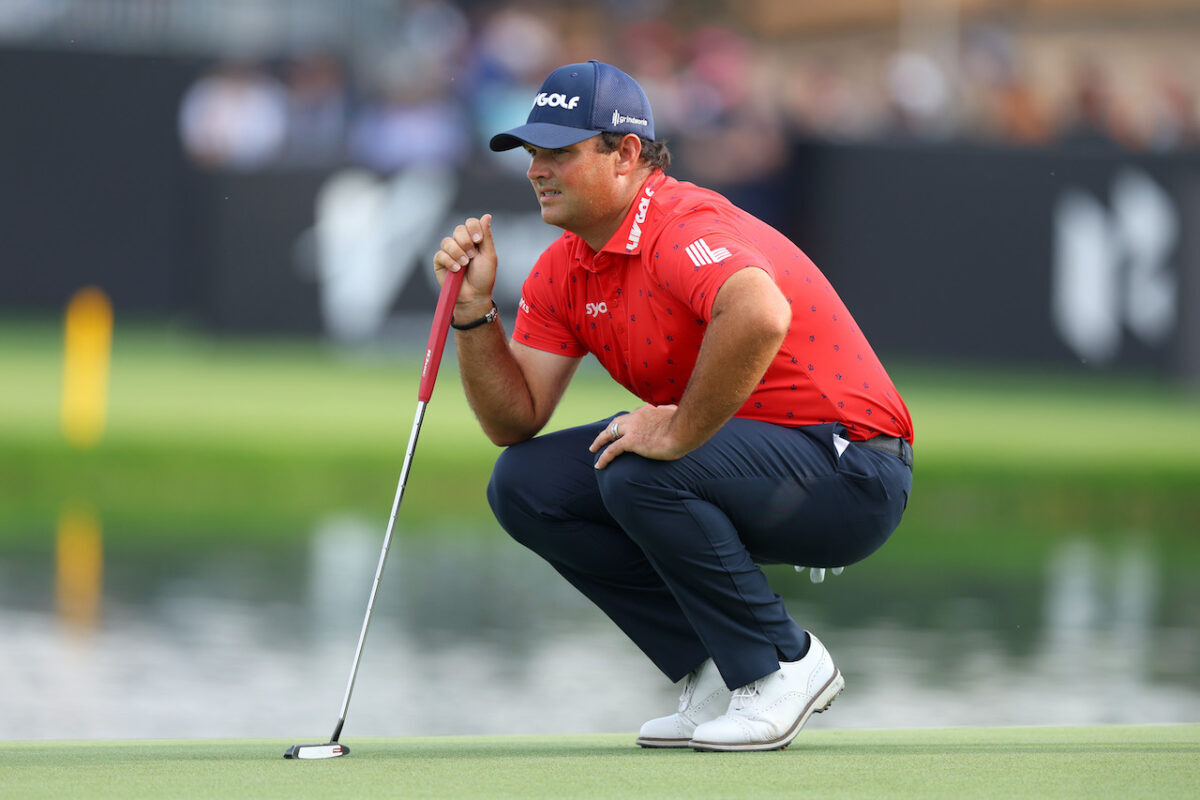









When professional golfers start comparing notes in the locker room about short putts they shouldn’t be missing, something unusual is happening on the greens.
That appears to be the case at this week’s Hero Dubai Desert Classic.
Ask Patrick Reed.
Reed is the leader heading into the weekend after a second-round 66 pushed him to nine under, one shot clear of England’s Andy Sullivan at the Majlis Course at Emirates Golf Club. But moving up the leaderboard hasn’t been easy.
“The way the golf course was playing yesterday with how firm and fast the greens were, you just couldn’t short-side yourself in the rough,” Reed said on Friday. “And I seemed to do that whenever I made bogey. Missed a couple short putts.”
In the second round, Reed found his touch on greens that perplexed large portions of the field.
“I heard a lot of guys talking in the locker room, missing a decent amount of short putts that we’re not used to missing,” he said.
The greens, he noted, were unusual in their look and feel.
“Yesterday, they had like a silver hue to them,” he said. “Whenever it gets windy, it just dries them out and it’s kind of hard to see the grain. Sometimes the ball glides instead of turning over. You don’t know if it’s going to break or stay straight.”
The Majlis Course, the first real grass course in the Middle East, opened in 1988 and has hosted the Hero Dubai Desert Classic since the tournament’s inception in 1989. The course was renovated following the 2021 event, with greens enlarged to provide additional hole locations and resurfaced with TifDwarf Bermuda, a high-performance, drought-tolerant strain.
Exactly what Reed was seeing is hard to say, according to Dan Cutler, superintendent at FireRock Country Club in Fountain Hills, Ariz. The “silver hue,” he said, could be related to grain, the directional growth pattern of grass. A colour change can also be brought about by stress, as blades go dormant in self-protection. It is not uncommon, for instance, for bentgrass greens to take on what looks like a bluish tint as a tournament week progresses.
But greens so fast that putts would “glide” instead of rolling? “I’ve never heard of that,” he said. “That would suggest almost no resistance, like throwing a bowling ball across an ice rink.”
Break, though, is a function of both speed and contour. When greens are lightning quick and holes are cut in slippery locations, even the world’s best players can wind up having fits.
Reed wasn’t alone in his assessment of the challenge. Rory McIlroy, a four-time winner of the event, also said that the putting surfaces have been especially tough.
“A lot of putts that looked like they were going to go in but didn’t,” McIlroy said.
Buckle up for the weekend. The greens won’t be getting any easier.
This article originated on Golf.com













Leave a comment