
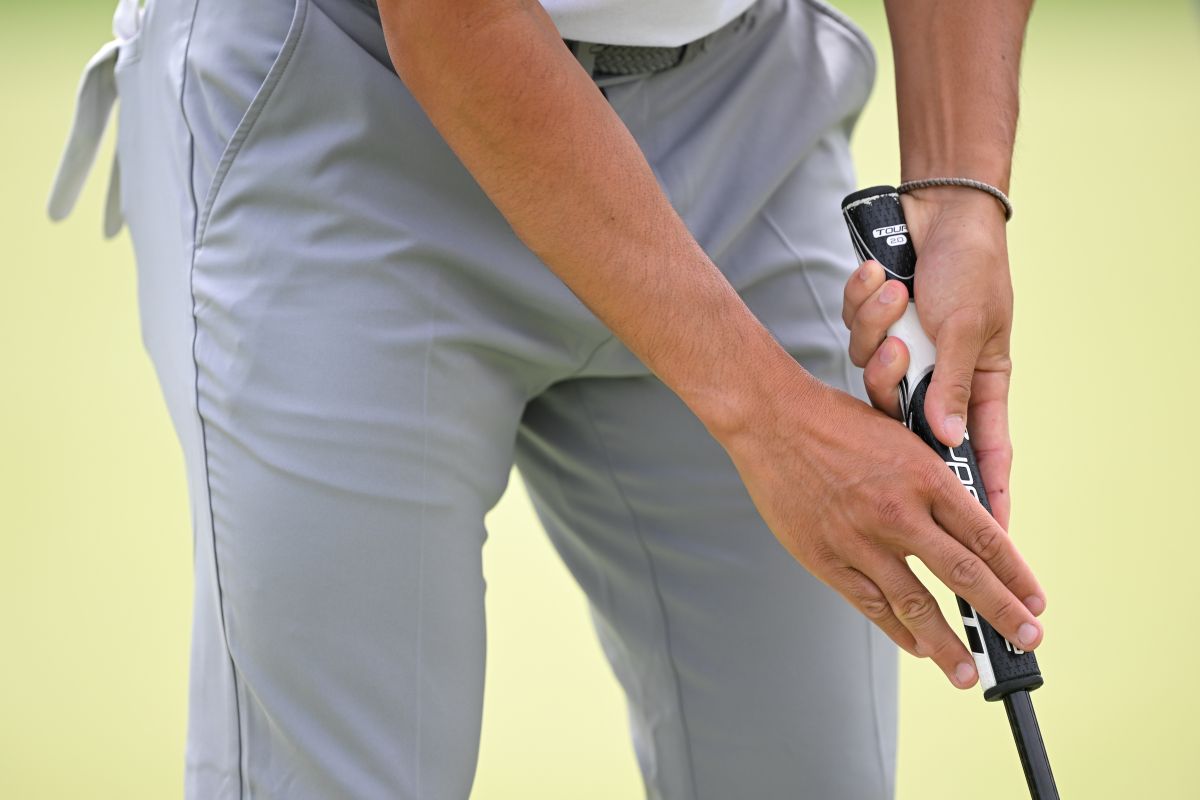








As many as one in two golfers suffer from the yips, but understanding why is the first step in getting past it.
There is a principle in psychology that whatever you resist, you strengthen. For anyone who has spent considerable time trying to rid their game of the dreaded yips, this will ring true. The harder you fight them, the worse the problem seems to get.
The yips, of course, is not a particularly technical term. It was coined by triple-major-winner Tommy Armour to describe the flatstick spasms that put paid to his playing career. But these days we see the word in a wider context, using it to refer to any involuntary movement – or indeed, as we shall see, absence of movement – with any club, at any point. Because of its mystery and horror, this affliction tends to go under the radar somewhat; but latest estimations suggest some form of twitch affects as many as one in two golfers. Put simply, if you’ve never had any problems in this area, you’ve been pretty fortunate.
To understand why trying to fix a yip only makes it worse, we need to get our heads around a tricky concept – the involuntary twitch we feel is actually a mental protection mechanism. The harder we fight the twitch, the more the brain feels the need to protect us… and the harder it makes us yip.
Confused? I don’t blame you. The brain can be a counterintuitive organ at times – this is one.
To try and make sense of this we need to grasp that our brains, obsessed with survival over millennia of evolution, have a nasty habit of responding to today’s world in ways that are frustratingly inappropriate.
A golf course should not be a threatening environment… but our brains can see it differently. A duffed chip, a missed short putt, a general inability to control a ball… these are all actions with the potential to arouse and threaten the ancestral parts of the brain that evolved around the need for approval, acceptance, and status within the safety of a group. The neural responses our predecessors developed to deal with threats – fight-or-flight – are well known. But there is also a less famous third response: a ‘freeze’, reserved for situations where fight or flight weren’t possible, and likely developed to avoid detection. Unfortunately, this ‘freeze’ response causes so many problems in modern-day, functional movement.
Imagine yourself over an important, short putt, with everybody watching on. You’ve already missed three today, and you’re understandably anxious. Your brain perceives this state of affairs as threatening, and tries to protect you. Fight is not an option. But freeze certainly is; if you’re immobile, you can’t hit the putt… and if you can’t hit the putt, you can’t miss it. Yet this option can only take you so far – you have to hit the putt at some stage – so the brain flirts with flight mode, trying to get the thing over as quickly as possible and get you out of there. One moment, it’s trying to stop you moving; the next it’s telling you to move as quickly as possible. In this conflicted state, is it any wonder that we feel such mental anguish, and produce such twitchy motion?
So, we can start our defence against the yips with the realisation our brains aren’t trying to sabotage us; they are actually trying to protect us. This realisation, hopefully, will go some way to discarding that horrible perception that we are having to fight ourselves, as well as the course and our opponents.
The second step is to update your mental software. Our brains are running outdated programs, based on genetics hard-wired from 30,000 years ago. And like most outdated software, glitches crop up.
Root your new software in a profound commitment to accepting all outcomes. You can miss the putt. You can duff the chip. You can even accept a twitchy stroke. It’s fine. You can deal with it.
This can’t just be lip-service. It must be a deep and genuine acceptance of whatever happens… one where, while you may not enjoy missing the putt, it doesn’t hurt you. That is potentially a major change of attitude and can take some soul-searching, but for anyone who has experienced the long-term pain of yipping, that’s an easy price to pay. Push this deep-seated acceptance on your brain, as often as you can. Thank it for trying to protect you, but make it clear that acceptance of all outcomes renders protection unnecessary. Those ancient, survival-based consequences no longer apply.
With this new, more appropriate mental software in place, try hitting shots in ‘Observation’ mode. At no point try to fix the flinch; simply try to stay awake to what happens at the crucial moment. Become curious about it. Did you feel a tightening in your dominant hand? Did your eyes dart about? Did time speed up, or slow down? These are all common freeze/flight effects.
You can gently challenge what you observe; but remember that the way out of yipping is a paradoxical one. Fighting it only makes it stronger; but when your brain understands that you are accepting it, it will drop all the security measures and settle down. And that’s when your movement starts to flow.
This article featured in our 2026-1 edition of Irish Golfer Magazine. To view the full magazine, click the image below.














Leave a comment