
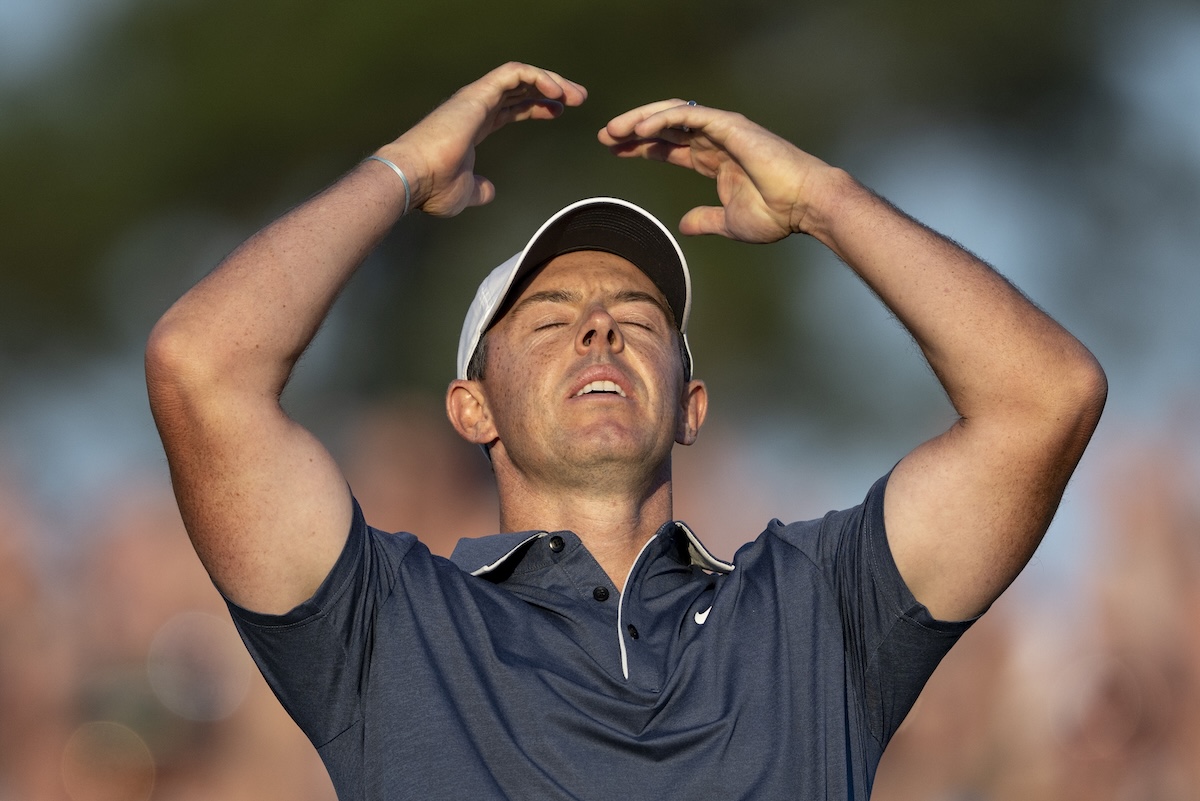



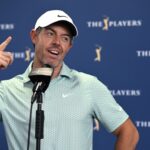
Rory McIlroy is a self-confessed fan of The Shotgun Start podcast, and the world number two was a surprise guest, joining co-hosts Brendan Porath and Andy Johnson for a section of Part 7 of their lengthy Year in Review series.
McIlroy covered a wide-range of topics during his half-hour on the show, and unsurprisingly, his reflections on his career-defining and Career Grand Slam completing final round at Augusta National back in April featured heavily, even though it was the previous edition of the Year in Review that dealt with the Masters.
“You know, reflecting back, what an amazing week. And if I was ever going to do it at Augusta, it was always going to have to be that way, just throwing up all over myself the last few holes,” he laughed.
McIlroy has repeatedly said that, through his work with renowned Sports Psychologist, Bob Rotella, he is “chasing a feeling”, and before going on to explain the final piece of advice that Rotella imparted prior to the final round at Augusta National, he attempted to clarify what sort of ‘feeling’ he was chasing.
“That childlike joy and enthusiasm,” he explained, going on to add that getting out to the golf course to play dominated his thoughts at school. “You know, playing until it’s dark and like just that joy and enthusiasm, like, it’s almost like an adventure. You’re just going around and you’re chasing this ball and you’re seeing shots and you’re you’re so in the moment and in tune with your senses and like, that’s the feeling that, once you finish your round of golf, like looking yourself in the mirror and being like, okay, that’s, that’s how I want to feel.
“That’s how I want to think. That’s how I want to act. And that’s it, right? You know, you’re just going back to the reasons why you started to play the game in the first place. You know, I’ve done that for the most part – I probably wasn’t thinking that way after the Masters – but, I feel like I felt that way for at least for most of the year.”
McIlroy also explained that his decision to ignore Bryson DeChambeau in the final group that Sunday had been inspired by a last-minute discussion with Rotella.
“I felt like the toughest thing I would have to deal with that day was Bryson himself and just the way we are completely polar opposites in terms of how we approach the game,” he said. “I felt like he was going to have a portion of the crowd and I was going to have a portion of the crowd and I was just having to deal with that a little bit.
“I said that to Bob Rotella – we always always met just by the caddie area before I went to the range every day – and he said, ‘How are you feeling today?’ And I said, I was feeling good but the one thing that I was uneasy about was just the pairing. And he said, ‘Well, just make him invisible. Just don’t engage, don’t look at him, just get lost in your own little world. You’ve got Harry beside you, have him be your companion and you just get lost in that world’.
“And that’s that’s what I tried to do, you know? But yeah, I felt like that was the biggest impediment between me and winning the Masters that day.. And then, once, it was apparent that that wasn’t gonna be the biggest impediment, then I made myself the biggest impediment.”
While Rory’s second shot into 15 – a high draw onto the par-5 green from behind the trees on the left side of the fairway – his second shot into 17 which set up a tap-in birdie, and his approach to the 18th on the first playoff hole which ultimately set up victory are the shots that will be best remembered, it was his play on the third and fourth holes of the day that he selected as being the most important.
“I think both three and four were huge moments,” he said. “You know, I was walking up the third fairway before Bryson had hit his second shot, one shot behind after starting two ahead. And then I was walking off the fifth tee box, three shots ahead. I was like, ‘what just happened?’
“So I think that it’s the second shot on three. It’s interesting, right? Like, I could not believe that Bryson laid up. I couldn’t believe it. I know now that that’s what he was really doing all week, especially to the left pins, but I just thought with how firm the greens were, it was hard to get a wedge shot close anyway, and I just thought he had a chance to drive it on the green. I didn’t think I could quite get there, but I felt like he had a chance to. You know, he’d just gotten one ahead, I felt like, even though it was early in the round, if he were to take driver out there and hit it on the green, it really is like taking the tournament by the scruff of the neck.
“I was just so surprised that he hit iron. And then he three putts and I ended up making a three and I just thought that was such a huge moment. I hit that good shot into four and make the putt, it was just, you know, if I don’t have those two holes after such a rough start, I probably don’t go on to win.”
It was an emotional rollercoaster for just about everybody watching, but for McIlroy himself, despite achieving golfing immortality, it’s a day he never wants to relive.
“There’s not one thing about that day that I would want back,” he admitted. “I’m happy that it’s over. I never want to feel that, but I might hope I feel that way on the golf course again because it means I’m playing for something very important. But I don’t know if I will ever feel that way again on the golf course.”
Last week, after competing in the Australian Open at Royal Melbourne, he flew home via Augusta and stopped into the storied Georgian club for the first time since that fateful Sunday.
“It was cool. I hadn’t seen my locker yet in the Champions locker room, so that was really cool. I had a lovely note left in there from Jack. You know, it was amazing,” he said.
As for the idea that, with the Masters monkey now off his back, he’ll be freed up and will go on to win many more green jackets?
“Yeah, it’s wishful thinking,” he shrugged. “I think it’ll make it easier. Whether it gives me pure freedom? No, I don’t think so, because I just don’t think that’s the way we’re wired.”







Leave a comment