
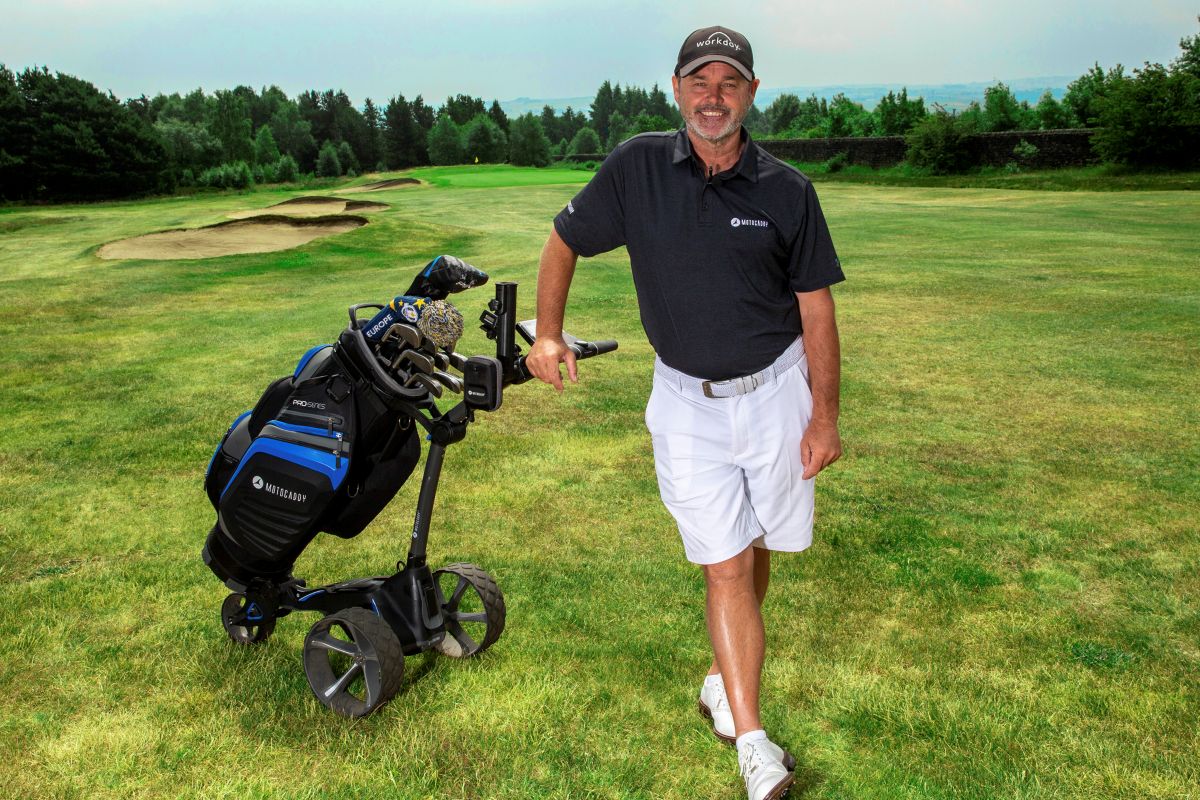



One of golf’s great unsung heroes, Billy Foster’s more than four-decade career on tour has provided him with more tales than most and an unrivalled ability to tell them. From the early days sleeping in tents, to caddying for Seve, Tiger, Clarke, and many more in majors, Ryder Cups and the Presidents Cup, it’s been a remarkable odyssey. By Mark McGowan
There aren’t many tour caddies whose names roll off the tongue, even for those with more than a casual interest in the sport.
Steve Williams, on the bag for Tiger Woods for 13 of his 15 major wins is one, Jim ‘Bones’ MacKay, caddie for five of Phil Mickelson’s six and one of Justin Thomas’ is another, and Harry Diamond’s close friendship with Rory McIlroy and the unjust criticism he’s garnered during McIlroy’s frequent major shortcomings adds him to the list.
And with over 40 years on tour and having worked with names like Seve Ballesteros, Lee Westwood, Darren Clarke, Matt Fitzpatrick, Segio Garcia, and even a moonlighting gig with Woods himself, Billy Foster’s name certainly belongs in that category.
During a sit down with golf influencer and podcast host, Rick Shiels, the affable Yorkshire man delved deep into his sizeable bag of tales from a life on tour that’s taken him to six continents, put him inside 16 Ryder Cup and one Presidents Cup team rooms, and finally delivered a major championship in 2022.
But where better to start than at the very beginning?
“There was a golf tournament at Bingley St Ives, my home club, back in the early ‘80s – 81, 82 and 83 – and I was a 15-year-old kid. There were no real caddies in those days because there was no money in it – you’d rock up on a Monday and they’d give you a dozen balls for the week, and that was it,” Foster recalled.
“I caddied for a Swede – Mats Lanner – and that was my first ever job. I was working as an apprentice joiner for my dad and getting £20 a week and sacked three times, and then I started going to a few other tournaments around Britain – Car Care Plan was a Moortown, Benson & Hedges was at Fulford in York, and then expanded to a couple in London and then a mate of mine said ‘let’s go to Spain on a six-week holiday and caddie down there’, which we did.
“I ended up caddying for Tony Johnstone from Zimbabwe, and he finished seventh in the Portuguese Open. If you finish seventh in a PGA Tour event now, you probably get $400,000 or so; he won £1,000 and I got five percent – 50 quid – and you’re paying your own way to Portugal, sleeping in bushes and tents, drawing your own yardage book. You couldn’t make a bean at it, but through that, we played a practice round with Hugh Baiocchi from South Africa and he took a shine to me and asked if I wanted to work for him full time.
“It was like, £20 apprentice joiner with my dad or travel the world with professional golf, so it was a no-brainer really.”
From there, Foster was poached by Gordon Brand Jr, and got his first taste of Ryder Cup action with the Scot in 1987 and again in ‘89, but even still, the lack of meaningful income and job security meant that, when he was offered a job as an assistant pro at Ilkley Golf Club in his native Yorkshire, he accepted and gave Brand Jr his notice that he was leaving at the end of the 1990 season.
Fate, however, had other ideas, and with just a few weeks of the season left, Brand Jr got drawn with Seve Ballesteros at the German Masters and the Spanish legend dropped a hint that he was looking for a new caddie for the following season and liked the cut of Foster’s jib. Foster, however, with his awaiting assistant pro’s job in mind, didn’t accept.
“I went back to my hotel that night and thought, ‘You’re some plonker, you. Your boyhood hero has just put it on a plate for you, and you didn’t even give him an answer’.”
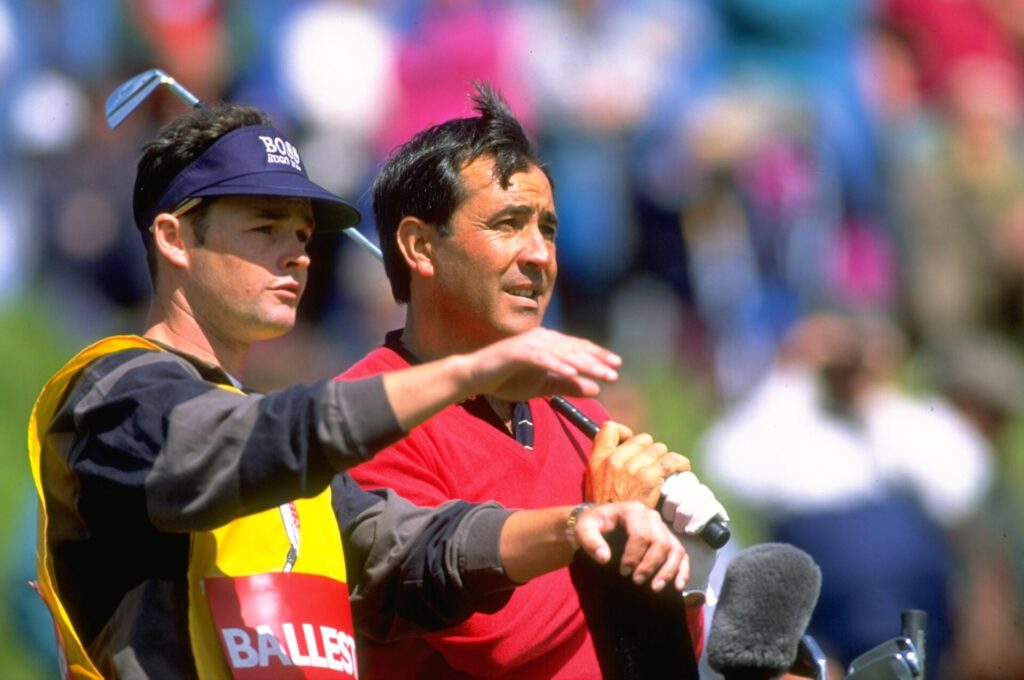
The assistant professional role would have to wait, and he spent the next five years looping for a player whom he described as being the Tiger Woods of his day.
Caddying in the 1980s and 1990s were vastly different from caddying in the modern era, not just in terms of the finances at stake.
“Nowadays, if you’ve got a shot over the lake and through the jungle at Sun City, caddies just go bang with the laser and see it’s 162 yards, I had a yardage wheel and this little box with string that, as you pulled it out, it would turn over numbers. I had to tie a piece of string to the back of the tee, abseil down a cliff, going through the jungle and pulling this string through trees and bushes. Around the lake, got to the green and I look at the box. 162 yards. One hour and 15 minutes it took me to get that yardage, and it was only the next day that I found out I’d walked through a cobra pit to get there.”
During his five years with Ballesteros, Foster had a front row seat to the golfing genius doing unbelievable things, including what he describes to this day as the greatest golf shot that’s ever been hit – Seve’s legendary shot on the final hole of the 1993 European Masters at Crans-sur-Sierre in Switzerland.
Ultimately, the fiery nature of the relationship came to a head at the Masters in 1995, and Foster moved on, first taking up Darren Clarke’s bag and then switching to Thomas Bjørn’s before returning to work with Clarke again for a period that included the 2006 Ryder Cup at the K Club where Clarke, shortly after the tragic death of his wife Heather, played through intense emotional turmoil in what Foster insists is the most special week of his 43-year-career.
“People expect me to say it’s winning the U.S. Open with Fitzy when you thought you were never going to win one, but it’s not, it’s that week with Darren Clarke,” he explained. “In six weeks, I went to Heather’s funeral and Clarkie’s left with two young kids, and he calls me up about three weeks later and says that Woosie – the captain – has just asked him if he’ll accept a wildcard to play in the Ryder Cup. I just said, ‘it’s unbelievably traumatic circumstances. If you’re asking me if your game is good enough to play, you’re still playing great golf, but the one thing I’ll say is that you’ve got to get ready for this incredible atmosphere, the unbelievable emotion, but it’s what Heather would want. She’d want you to play and win it for her, so I’ll leave you with that’.”
Clarke, of course, did play, and went on to win all three of his matches, and the first tee on the Friday is something that Foster will never forget.
“I’m sitting here 19 years later and it’s still giving me goosbumps,” he said. “The crowd were all standing up, stamping their feet, singing ‘Olé, Olé, Olé’ and it was like Wembley Stadium. I just thought, ‘Oh my god, how is he going to hit this tee shot.’ I had visions of myself hitting a foot behind the ball, but he bombed it 310 and made birdie, then birdied the last hole to win the match against Chris DiMarco and Phil Mickelson.”
Playing alongside Lee Westwood again in the Saturday fourball session, Foster recalled that Clarke struggled while Westwood carried the pair before Clarke chipped in on 16 to secure a 3&2 win over Tiger Woods and Jim Furyk. With the good of the team in mind, Foster had caught assistant captain Peter Baker’s eye and whispered that Clarke was out of sorts which led to Clarke being left out of the afternoon session.
Clarke became aware of Foster’s intervention, and was livid, refusing to speak to his caddie for the remainder of the day.
“I said Clarkie, ‘I’m sorry for what I did yesterday but I did it for the good of the team and the good of yourself. If you want to sack me, sack me. But let’s get out there, beat Zach Johnson and win the Ryder Cup for Heather. Then you can sack me’.
“Four hours later, he’d done all those things, and I was hugging him in tears on the 16th green as he’d won the Ryder Cup for Heather. That would be my most special memory in golf even if I caddied until I was 80.”
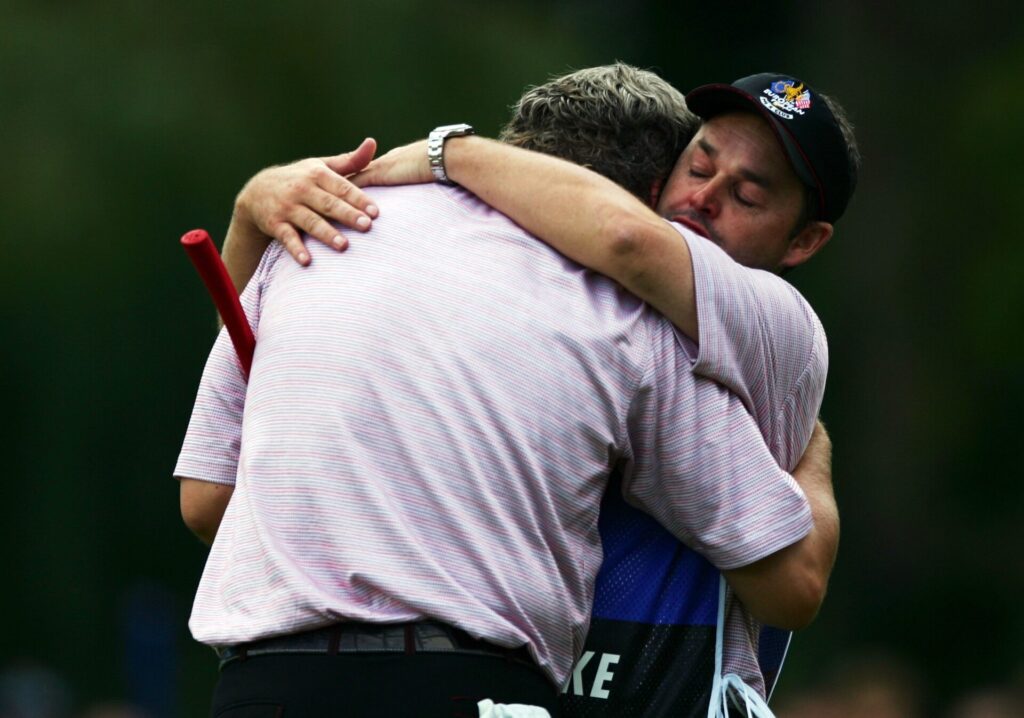
The Ryder Cup is special to everybody involved, and Foster, with a record 16 appearances – 15 as a caddie, and one as a special advisor – says it’s no different for the players’ caddies.
So much so, that he genuinely says that he’d refuse to caddie for an American player in the biennial contest.
“There’s not a chance on earth,” he definitively declared. “Not a chance. There are a few American caddies who work for Europeans and their take on it is ‘that’s my boss, I work for him wherever he goes’, and I admire that. Personally though, not a chance.
“There were rumours years ago that Tiger Woods was gonna ask me to work for him, so it starts going through your head – what would you do? I caddied for Collin Morikawa at the Scottish and the Open this year. If he’d asked me to caddie for him for the rest of the year, I’d have said ‘yeah, but I can’t do the Ryder Cup’.
“The Ryder Cup, it’s in my blood, so to go turncoat and caddie for one of them, I’d be giving wrong yardages on purpose. Honestly, I couldn’t do it.”
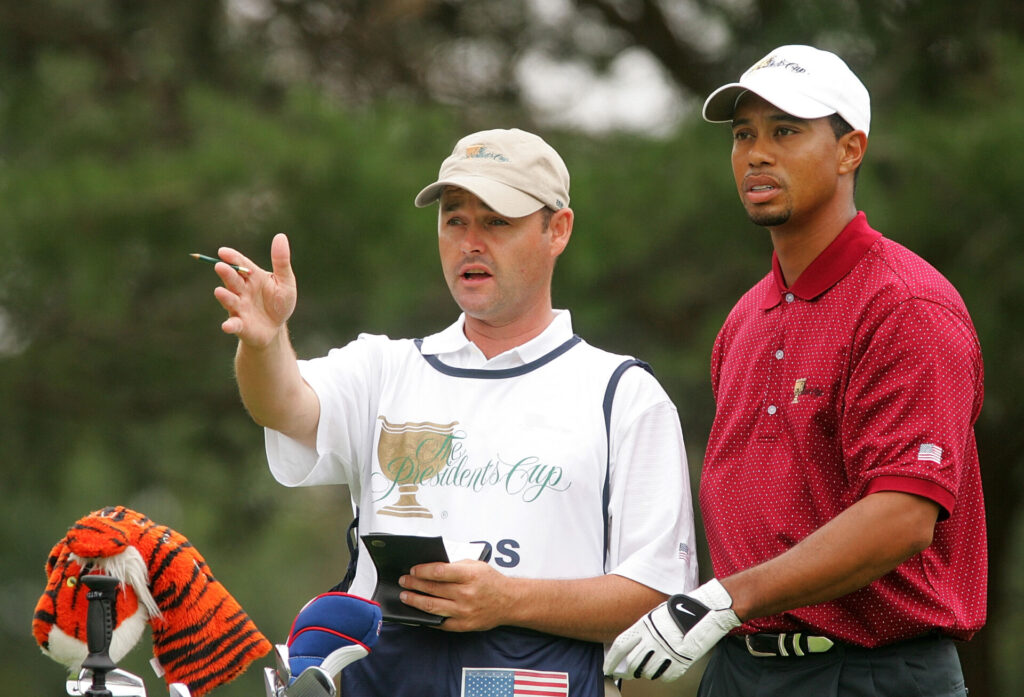
While the call to caddie full time for Woods never actually materialised, he did moonlight for the great man at the 2005 Presidents Cup when Williams, Tiger’s regular caddie, was at home with his wife who was expecting the couple’s first child.
And in typical Foster fashion, the tale of how it came about is glorious.
“I was on the range with Darren Clarke at Akron, Ohio for the Bridgestone and Tiger comes along and starts talking to Darren. About two minutes later, Darren turns around and tells me that Steve Williams’ wife is having a baby and he wants you to caddie for him for the week and he’s just asked me if that’s alright. What are you going to do?
“I said I didn’t know, and Westy, who’s hitting balls beside us, turns to me and says ‘Billy, if you don’t work for him, I will!’”
Foster says that the circus surrounding Woods is like nothing he’d seen before, even caddying for Seve, but the seeds for their relationship had been sown in an unorthodox manner.
At the 2002 Ryder Cup at the Belfry, Clarke and Bjørn were preparing for the opening match against Woods and Paul Azinger, and as the players were going through their final preparations, nature called for Foster.
“I go into the toilet and sit down, look across and see there’s no toilet paper so, full reverse and I head into trap two and see loads of toilet paper,” he chuckles. “Next minute, I hear spikes on the bathroom floor, ‘morning Tiger’, says Cubby, Davis Love III’s caddie as he’s leaving, and the door closes on trap one, where I’ve just come from. I listen and I hear a little crackle, and I’m crying. There’s six minutes to tee off, and I’m the only man in the world who knows that Tiger’s in there with no toilet paper.
“I’ve got a vision of him walking like John Wayne up the first fairway, and I hear this little sigh and think, ‘I can’t do it to him’. So, I’ve gone back, rolled up about 20 sheets, and gone down on my hands and knees under his toilet door. You talk about Maradona being the hand of God, I was the hand of God that day for Tiger Woods. ‘You might be needing these’, I said, then walked away and shouted ‘Europe 1UP’.
“Sure enough, we beat them 1UP, but he came out of that toilet with the biggest smile, and I said, ‘you owe me big time, Tiger’ and he said it right back, ‘I owe you big time, Billy’. And I think that’s why I got the job.”
With his resume, few people are better qualified than Foster to delve into the narrative that Harry Diamond, in his role as Rory McIlroy’s caddie, is somehow holding McIlroy back. And it’s a narrative that Foster unequivocally refutes.
“It’s uncalled for,” he declares. “We all know that if it’s left or right, it’s the coach’s fault and if it’s long or short, it’s the caddie’s fault. It’s never the player’s fault. But I’ve always defended Harry. I think he’s got a lot of unnecessary abuse, really. He’s a +2 golfer, he’s a good player, he’s been Rory’s best mate since they were eight years old, he respects him, and he wouldn’t be scared telling him what he thinks. He’s a good caddie.
“Sure, there are one or two instances where he should’ve done this or should’ve done that, but Rory is his own boss. Rory will do what he wants to do, at the end of the day. He’s always been a positive player in going for things, and that’s not Harry’s fault. He does a really good job.”
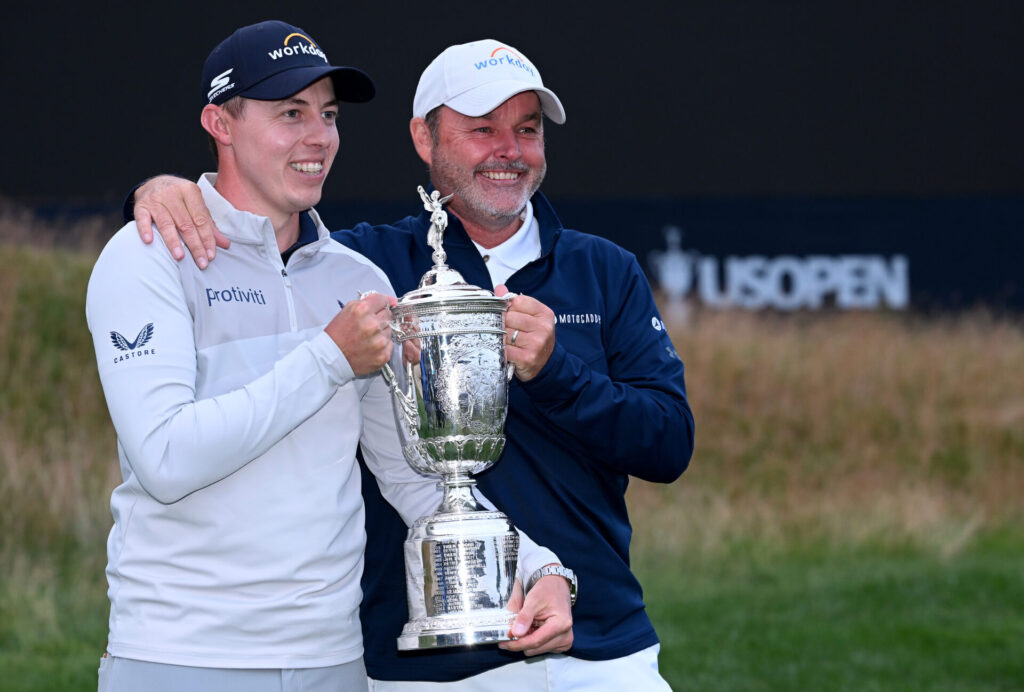
Despite aiding Matt Fitzpatrick to a career-high sixth in the world rankings and to U.S. Open glory at Brookline in 2022 – a fitting accolade given that Foster, despite being widely regarded as one of the greatest caddies of all time, seemed destined to end his career without a major victory – the pair parted ways in early 2025 after a six-year relationship.
Now 61, and with more than four decades of tour life behind him and the memories of living paycheque to paycheque firmly behind him, he’s content to do part-time gigs, though he does admit that the short stint reunited with Lee Westwood earlier this year opened his eyes to what LIV has to offer.
“Do I really want to do a full, 30 event transatlantic schedule?” he muses. “It’s a tough one. It’d have to be a player that really excites me, it’d have to be the right player, one that I think I can help improve to another level.
“I still want to caddie, of course I do. LIV Golf has obviously been designed by the Caddie’s Association,” he quipped. “It’s so much more appealing, you’ve got to be honest about it. The caddies love it, and why wouldn’t they?
“You think about it – if you’re going to Los Angeles, say, to Riviera. You pay for your flights, pay for your hotel, pay for your hire car, pay for your food, pay for your beer, pay for your yardage book. (It’s roughly $100 for a yardage book at a PGA Tour event).
“You work all week and if your player misses the cut, you get a weekly salary, but that doesn’t really cover your expenses. So, flip that to the LIV Tour, and your flights are paid for, your hotel is paid for, you eat with the players because you’re not treated like a rat tied outside the clubhouse like I have for much of my career where we weren’t allowed in the clubhouse or locker room, it’s three rounds and then 50th place prizemoney is $100,000 and there’s 54 players.
“So, from a caddie’s point of view, you can see where I’m coming from.”
While LIV’s arrival might be a godsend for caddies, the uncertainty that it continues to cast over the Ryder Cup in terms of players and future captains is cause for concern. But in some ways, that’s been a blessing in disguise, as far as Foster is concerned because it brought Luke Donald to the fore.
“I’ve often been asked, out of all the Ryder Cups I’ve done, who was the best captain and I’d always have said Paul McGinley… Until now,” Foster says. “What Luke Donald has done in the last two Ryder Cups has been off the charts. You see it firsthand, you listen to what he has to say, he leaves no stone unturned, his stats are brilliant, but he’d never have been a Ryder Cup captain.
“Lee Westwood would’ve done it in Rome, Poulter would’ve done this one, and it’d have been G-Mac in Ireland, and then Sergio Garcia would’ve done the next one at Hazeltine. Henrik Stenson got the one in Rome by default because Westy was banned, so he wouldn’t have been one, and Luke would’ve been bypassed. Luke got it because Stenson then got banned, and now he’s going to go down as our best ever Ryder Cup captain.”
But does he think Donald will return for a hat-trick of captaincy stints at Adare Manor in 2027?
“Well, he hasn’t said no, has he?” And there’s no natural successor. It’s funny, I had a chat with Rosey on the Sunday night in New York outside the players’ room, and we had a chat about the next captain. I said, ‘well, we know who the frontrunner is. It’s you, but only you can decide if you still want to play’. He’ll be 47, but will his game still be good enough? You’d have to say it might be, so if he wanted it, he’d probably get it, but Luke hasn’t ruled himself out so that to me suggests he’ll do it again.”
And who does Foster see as the leader of the opposition at Adare Manor?
“I think Tiger will do it at some stage; it just depends on where he wants to do it. But he’s big friends with JP McManus, so yeah, it could well be.”
But he thinks that the door on Westwood, Poulter and McDowell’s captaincy hopes may be forever closed.
“I think it might’ve gone,” he laments. “For the sole reason that, by the time they would get it, they might be in their late 50s and then you’re not in touch with the young players anymore. I can see it sliding past them, unfortunately, and they would’ve been great captains. I hope it doesn’t, but you can see where I’m coming from.”
And where he’s coming from is a position where the good of the team trumps all. It’s not everybody that can claim that, but when he’s literally risked encounters with venomous snakes to grab a yardage, nobody can deny Foster’s status as a great team player.
The above feature appeared in the 2025-8 edition or Irish Golfer. To view the full edition click below









Leave a comment