








There are many factors that come into consideration when deciding the pairings for any Ryder Cup session, but for foursomes, and the opening foursomes in particular, there are lots more.
It’s notable that Russell Henley is the only Ryder Cup rookie who’ll feature in the opening session this time around. With 11 of the same 12 players that played in Rome on the European side, it’s no major surprise there, but the U.S. side have U.S. Open champion, J.J. Spaun, one of the most consistent performers of the year outside of Scottie Scheffler in Ben Griffin, and native New Yorker Cameron Young also playing in their first Ryder Cups.
Henley’s partnership with Scheffler at the 2024 Presidents Cup and his ability to put the ball in play meant he was always going to partner Scheffler again, so that’s no surprise, but it seems that Bradley in particular is going to lean heavily on experience in the opening session.
And he’s going to lean into the crowd too. It might be just after 7am in New York when the first shots are struck in anger, but the energy will be more like that at 10pm at a music festival where the headline act have just walked on stage.
And in some respects, they will.
By sending Bryson DeChambeau and Justin Thomas out first, he’s guaranteed that the roof will be blown off from the word go. It’s a gamble playing DeChambeau in foursomes, and it’s an even bigger gamble in sending him out this early, but it’s a gamble Bradley’s deemed worth taking.
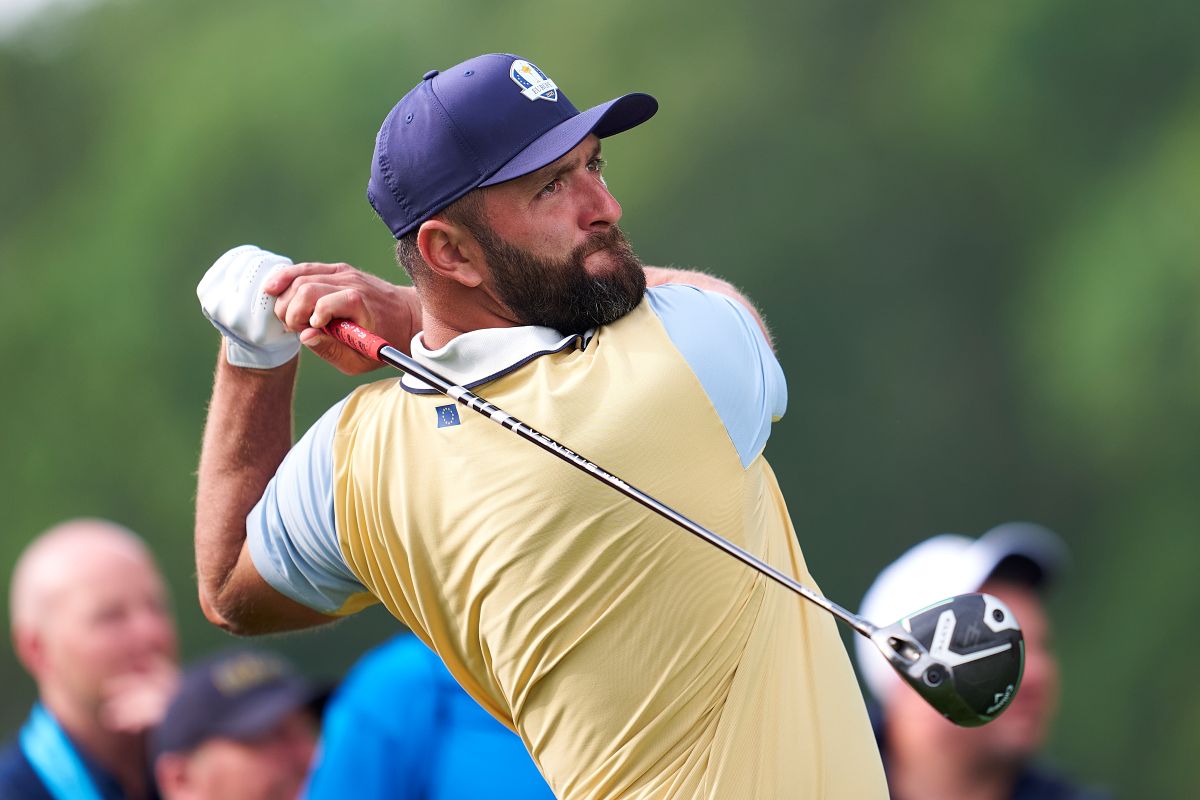
In selecting Jon Rahm and Tyrrell Hatton as Europe’s lead-out pair, Donald has opted for the tried and tested route. They were first off in 2023 too, they are close friends, and they both know each other’s games inside out.
In fourball matches, you play your own ball, you play your own game, and you hope that between the two of you, you make enough birdies, win enough holes to get the job done.
In foursomes, it’s very different. You need to be comfortable with your partner, sometimes need to play to your partner’s strengths as opposed to your own, and the odds are high that if one of you underperforms, you both lose. That’s a different kind of pressure.
You also need to be comfortable playing each other’s ball.
For the typical weekend warrior, the golf ball you’re using has little-to-no impact on how you play. At elite levels, it’s massively important.
So let’s take a look at what balls the players use.
DeChambeau and Thomas are both Titleist guys, but while Thomas plays a ProV1x, DeChambeau uses a modified version – the Titleist Pro V1x Double Dot (Prototype). It flies lower, spins less on full shots, but performs like the ProV1x on shorter shots. DeChambeau bombing it off the tee shouldn’t impact Thomas’ ability to control it on approach, so they should both be comfortable.
Rahm uses the Callaway Chrome Tour X while Hatton is a ProV1x man. Their foursomes record is good enough to suggest that they’ve found a formula that works, even though both balls perform differently.
Match number two sees Scottie Scheffler and Russell Henley taking on Ludvig Åberg and Matt Fitzpatrick.
Scheffler and Henley both use Titleist balls, but Henley uses the lower-spinning ProV1x. Here, it’s likely that they’ll both use the other’s ball off the tee, allowing the player hitting the approach shot to feel safely in control. Åberg and Fitzpatrick both play the ProV1x so any doubt is taken out of the equation there.
The Harris English and Collin Morikawa pairing was the most surprising of Bradley’s selections for the opening session, and English plays the ProV1x while Morikawa uses the TaylorMade TP5x. They play Rory McIlroy and Tommy Fleetwood, who also use TaylorMade but with Rory opting for the higher-spinning TP5 and Fleetwood using the TP5x. When they went two-for-two in foursomes in Rome, McIlroy was using the TP5x, but both these pairings will swap balls on the tee to give the player hitting the approach the higher comfort level.
The final match is another where both Europeans play identical balls as Bob MacIntyre and Viktor Hovland both play the standard ProV1, whereas Patrick Cantlay is a ProV1x user and Xander Schauffele favours the Callaway Chrome Tour. Like Rahm and Hatton, the American pair have played each other’s ball in foursomes often enough to have a formula that works.
In a Ryder Cup that promises to be as close as this one, marginal gains could prove decisive. How much the ball choice factored in Donald’s decision to pair Åberg and Fitzpatrick and Hovland and MacIntyre only he knows, but it won’t have counted for nothing.













Leave a comment