
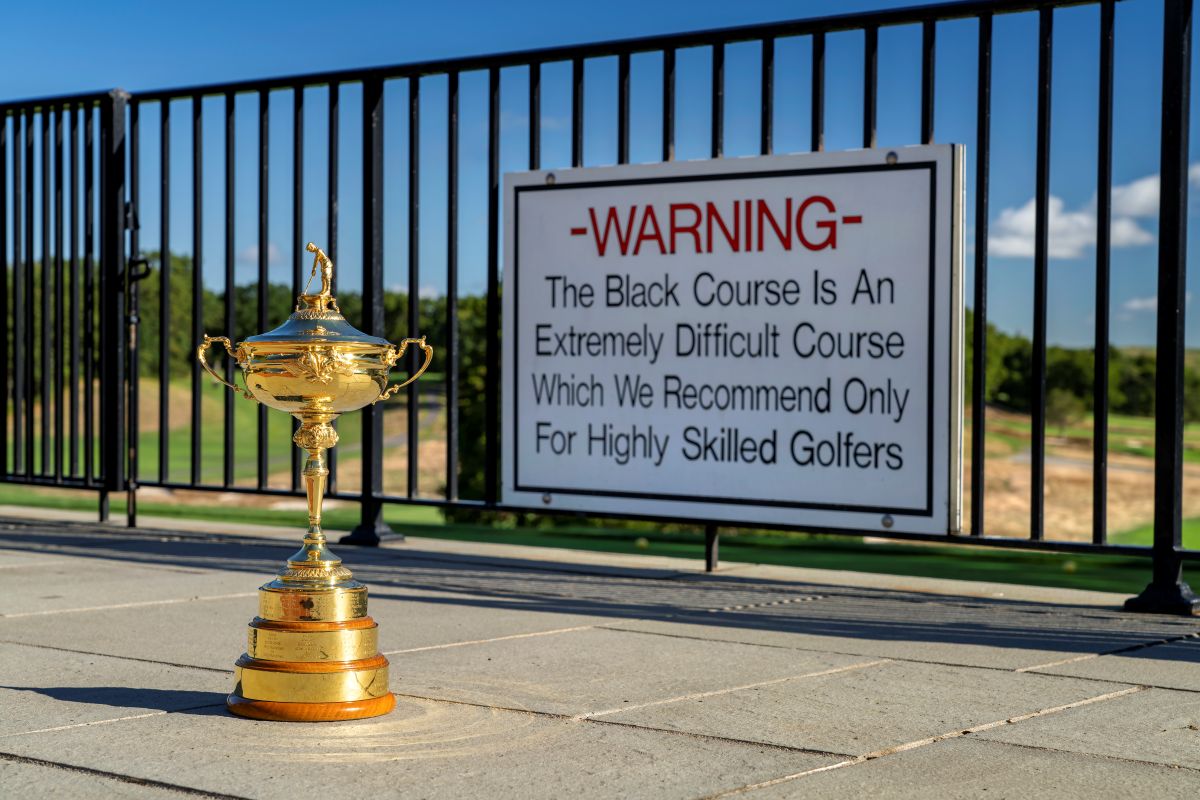









It may not be the only show in world golf this week, but it might as well be.
Since Scottie Scheffler tapped in from about a foot on the 72nd hole at Royal Portrush, the Ryder Cup has been the metaphorical elephant in every elite men’s golfing room, and we’re now just 48 hours from the opening tee shots being hit.
The teams are long picked, the uniforms decided, heads measured to ensure that all hats fit, and the overall golf course setup finalised.
So, what remains to be picked over?
Well, in this series we’ll take a look at the big questions that remain to be answered.
3. How does the golf course itself influence outcome?
Any time a big tournament is staged at Bethpage Black, the famed sign pictured above gets plenty of media play. Quite when it was placed on the guardrails close to the first tee are up for debate, but for decades, it’s served as a warning to those unfamiliar that the golf course they’re about to tackle might be a literal walk in the park, but far from a figurative one.
But when you’ve got 24 of the best players on the planet, it’s safe to assume they tick the ‘Highly Skilled’ box.
But which set of highly skilled players will it favour more?
Eight of the last nine Ryder Cups have been won by the home side, and the odd one out in that run is dubbed ‘The Miracle at Medinah’, and golf course setup has certainly played its part in that. How much of a part, however, is up for debate.
European setups have tended to feature thicker rough and narrower fairways, placing a higher premium on accuracy. U.S. setups, on the whole, have seen the rough trimmed down and wide landing areas, and under instruction from U.S. captain Keegan Bradley, the golf course that was handed over to the tournament officials this week is no different.
This, combined with the heavy rain scheduled to fall on Thursday, means that most of the teeth will have been blunted if not entirely removed.
But how much of a benefit is that this time round?
In the past, many of the European team members secured their places on the team by competing on the European Tour, as it was then known, and the Americans secured theirs by competing on the PGA Tour, with major championships being the few crossover points.
Now, three of the players – Jon Rahm, Tyrrell Hatton and Bryson DeChambeau – have played most of their golf on LIV, while the remaining 21 have all spent the majority of 2025 playing PGA Tour golf. This means they’ve been presented with identical sets of challenges, been asked to hone similar sets of skills, and, with varying degrees of success, they’ve all excelled enough to either qualify automatically or warrant a captain’s pick.
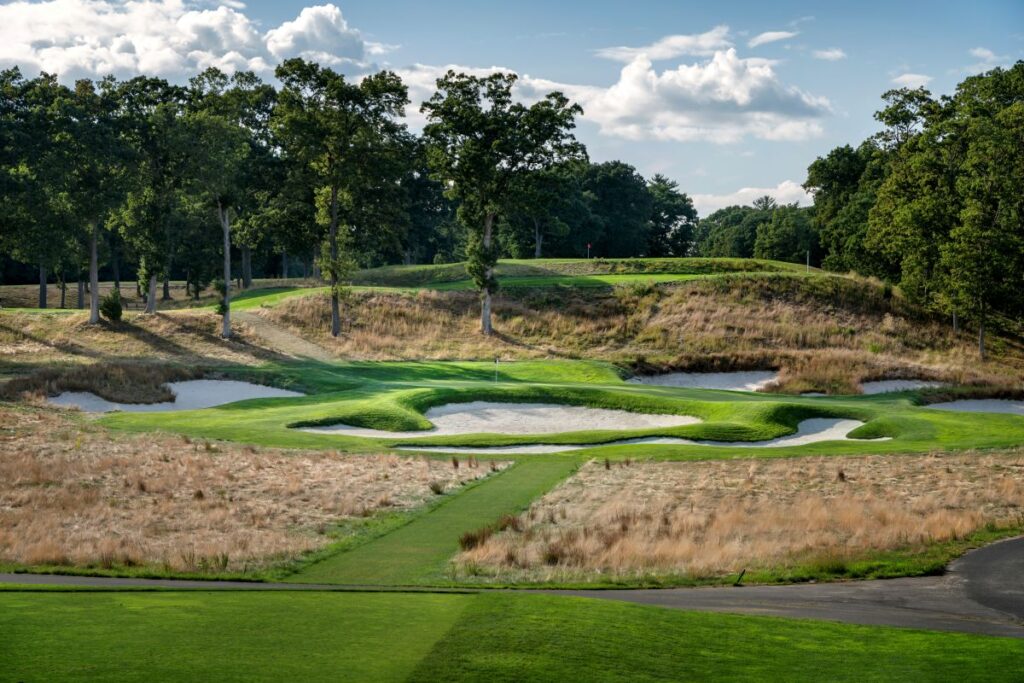
Bethpage Black is long, and playing soft, is even longer. Some tees have been moved up to accommodate grandstands, but even still, length is always going to be an advantage here.
In DeChambeau, the Americans have the biggest hitter of the 24, but in Rory McIlroy and Rasmus Hojgaard, the Europeans have numbers two and three, and the two sides split the top six evenly at three apiece, the top eight evenly at four apiece, but four of the six shortest hitters are all European.
DataGolf analysis suggests that, on average per player, the Americans will be 0.4 yards longer and will hit 0.6 more fairways, will hit it marginally closer, chip it marginally better, and hole marginally more putts. But “marginally” is the optimum word, because it really is that close.
The days of Europeans, used to playing on green measuring “9” on the Stimpmeter being bamboozled by greens rolling at “12” are long gone, and it’ll likely come down to which set of players hold their nerve over the five- to 10-footers, who chips-in more often, and who is able to rescue a half-point from the jaws of defeat or turn what looks destined to be a tie into a full point.
In a strokeplay event, it’s easy to pick out specific holes where a birdie is a must or where double-and triple-bogeys can lurk, but in matchplay, it’s less of an issue. Matching or bettering your opponents’ score is all that counts, and it doesn’t matter if it’s a two, three, four, five, or six that wins a hole.
The golf course is the mere canvas on which the artists paint. And this week, it’s not going to be more receptive to either red or blue.












Leave a comment