

It may not be the only show in world golf this week, but it might as well be.
Since Scottie Scheffler tapped in from about a foot on the 72nd hole at Royal Portrush, the Ryder Cup has been the metaphorical elephant in every elite men’s golfing room, and we’re now just 48 hours from the opening tee shots being hit.
The teams are long picked, the uniforms decided, heads measured to ensure that all hats fit, and the overall golf course setup finalised.
So, what remains to be picked over?
Well, in this series we’ll take a look at the big questions that remain to be answered.
- Who plays in the opening session?
As sporting clichés go, the old “you can’t win it on the first day, but you can lose it…” one certainly has more than just a kernel of truth. We need look no further back than 2023 when Europe completed a clean sweep of the opening foursomes session, took two-and-a-half of the points in the afternoon and led by five at the end of the day. The eventual winning margin? Four points.
You don’t even need to go back that far, in fact. Take last year’s Solheim Cup. The United States won both Friday sessions 3-1, led 6-2 on the first night, and won by three overall.
You can recover from losing the first session and go on to win as Europe did in 2018, 2012 and 2010, but it’s an uphill task and they did so by winning all four of the afternoon matches in ’18 and both ’12 and ’10 went right to the wire.
So, a fast start isn’t an absolute necessity, but it makes the job a hell of a lot easier.
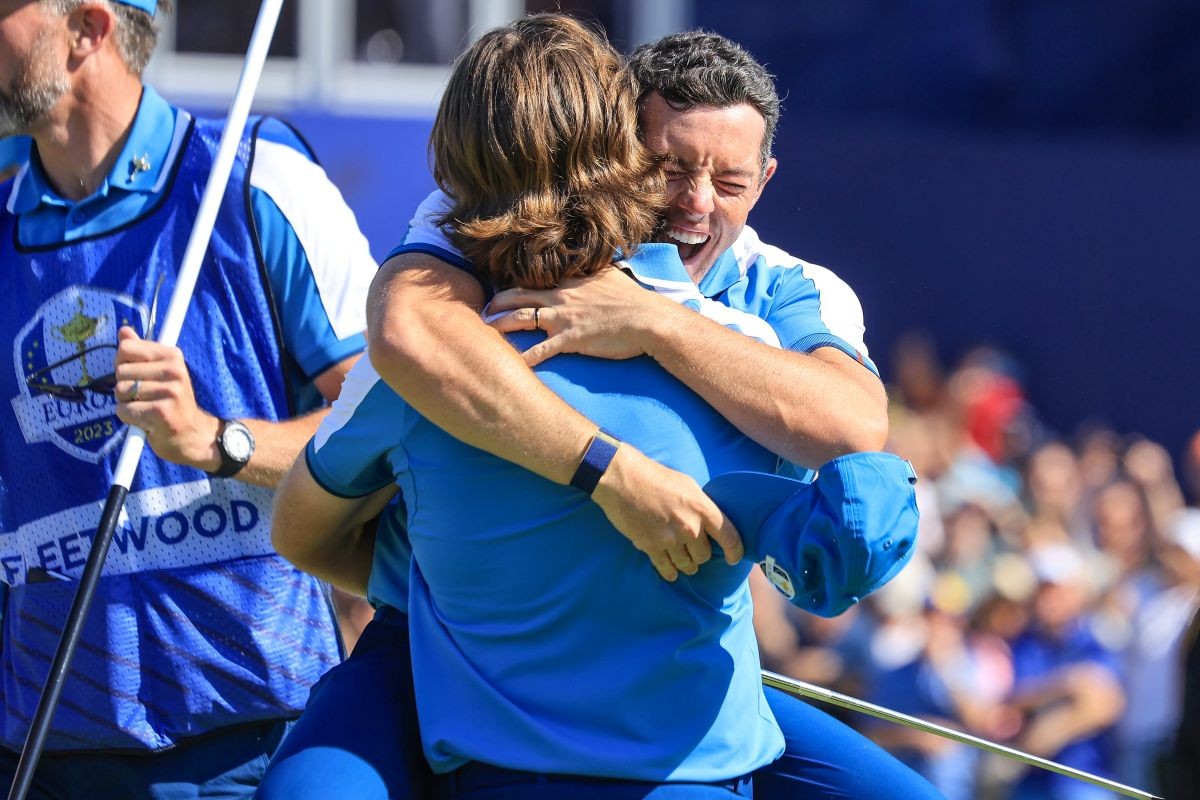
In Rome, Donald switched up the traditional format that saw European-hosted Ryder Cups start with fourballs and opted to go alternate shot right out of the gun. He sent Jon Rahm and Tyrrell Hatton out first, followed by Ludvig Åberg and Viktor Hovland, Shane Lowry and Sepp Straka, and Rory McIlroy and Tommy Fleetwood. Then, he sent the same groups out again on Saturday morning, though in different order. They delivered seven out of a possible eight points.
I’d wager that six of those eight players are guaranteed to play in the opening session this time around, and it would be a big shock to me if the Rahm and Hatton, McIlroy and Fleetwood, and Åberg and Hovland pairings aren’t revived.
At 45, Justin Rose is the oldest player on either side, so there might be the temptation to keep him for the two fourball sessions as Donald did in Rome, but while he might be 45, Rose’s strict dedication to health, fitness and recovery means he’s capable of more if required.
I think Donald will be tempted to pair him with Lowry. Shane has become one of the best ball strikers in the game, but is prone to streaky putting. In theory, foursomes should suit because on half of the holes, he’ll be trying to stick Rose in close and give the steely Englishman the birdie putt. Lowry is also prone to frustration, and who better to keep him in the proper mental frame than a man who has suffered heartbreaking loss with as much dignity as humanly possible.
Rasmus Højgaard isn’t just identical to twin brother Nicolai in appearance, their golf games are eerily similar too, and Nicolai was deemed better suited to fourball than foursomes and I see no reason why Rasmus, whose form is questionable, will be looked upon any differently.
Straka’s form is questionable too, so again, I think he’ll be kept for fourball matches, but Matt Fitzpatrick has been one of the best players on the planet over the past four or five months, and Bob MacIntyre is a much more complete player than the one who played in Rome. You could make a case for both of them to play instead of Lowry and Rose, or to mix and match – Rose and MacIntyre, Lowry and Fitzpatrick – but I think Fitzpatrick’s foursomes record (played three, lost three) will work against him, and Donald will be conscious of the need to get off to a fast start.
On the U.S. side, there are a lot more variables in play. All the evidence points towards Russell Henley being the man paired with Scottie Scheffler, who is the only one of the 12 players absolutely guaranteed to play the opening session. They matched up well and went two-for-two at last year’s Presidents Cup, and, in my mind, it’s only a question of which slot of the four they occupy
Patrick Cantlay and Xander Schauffele have been the most consistent pairing since Tiger Woods first teamed them up at the 2019 Presidents Cup, and despite Schauffele’s injury-hampered season, they are another easy partnership to put out when few others are tried and tested.
It’s likely that Cameron Young will be held until the afternoon fourball matches on day one, while Collin Morikawa’s form has dipped alarmingly over the past few months so sending him out in foursomes would be a risk though his traditional skillset makes him typically ideal.
I think J.J. Spaun will play in the opening session and I can see him paired with Sam Burns. Burns didn’t cover himself in glory playing alongside Scheffler last time around, but it’s never easy playing with the world number one and Spaun is the sort of gritty competitor that can bring out the best in Burns.
That leaves one more pairing.
On form, Ben Griffin is one of the top three or four players in the U.S. side, but with Henley and Spaun also playing in their first Ryder Cups, Keegan Bradley might see it as too much of a risk in putting another rookie out in the opening session.
That leaves Bryson DeChambeau, Harris English, and Justin Thomas.
As one of the automatic qualifiers, English might feel a little hard done by if he’s not picked to play in alternate shot, and could easily step in Burns’ place alongside Spaun, or with Thomas or Morikawa in the remaining pairing, but I feel he’ll be held in reserve for the fourball matches on day one.
There are many good reasons not to play DeChambeau in foursomes. His questionable iron play is one, his foursomes record is another (played three, lost three across Ryder and Presidents Cups), but Bryson may be the wildcard in the deck. Let’s not forget that Bethpage Black is a ‘Big Boy’ golf course, and there is no bigger boy than Bryson. He can reduce the long par-4s to a flip-wedge for his partner, and he’s got the short game and putting to make up for the limitations in his approach play.
Bryson playing and playing well will energise the U.S. crowd in a way that no other player – not even Scheffler – can come close to matching. I think it’s a gamble worth taking. And I’d pair him with Justin Thomas, who’s thrived in the ‘whooping’ and ‘hollering’ environment of a team golf competition on U.S. soil.
We’ll have the definitive answers to this question on Thursday evening. The other questions in this series won’t be definitely answered until much later.






Leave a comment