
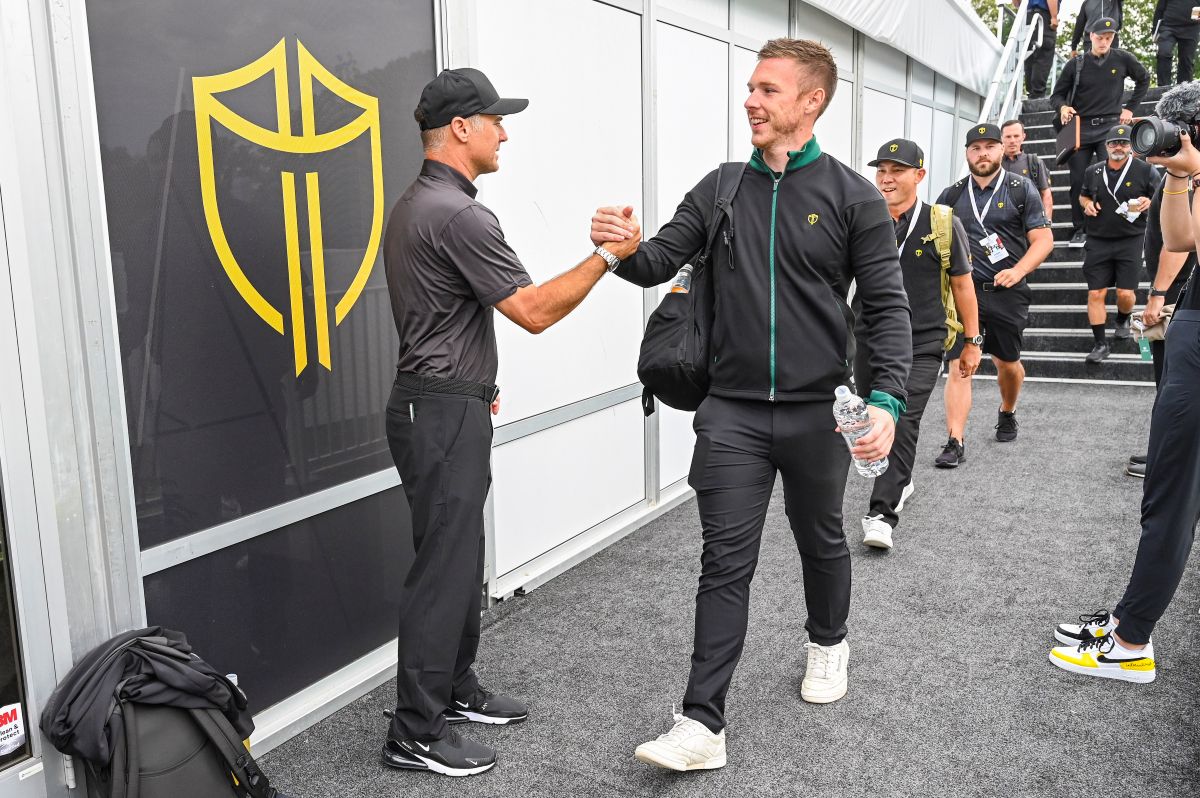








How a young Carrick-on-Shannon man with a keen eye for golfing numbers became an intricate part of European Ryder Cup glory and the Internationals side’s Presidents Cup revival.
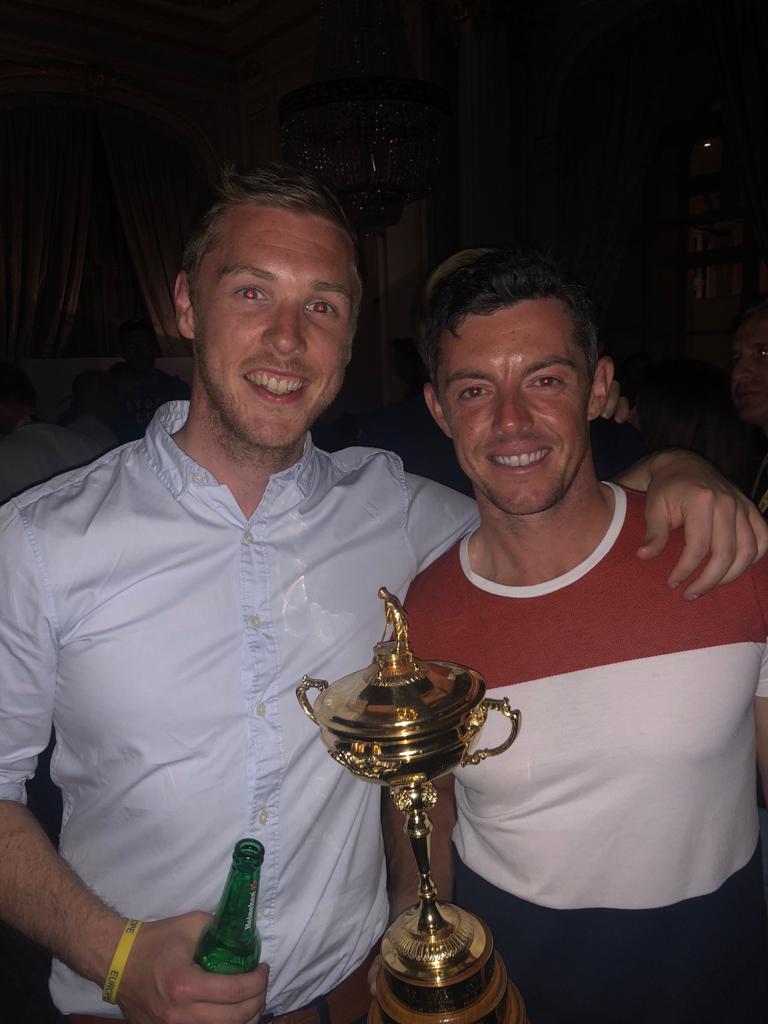
When he graduated with an Engineering Degree from NUI Galway in 2014 as a fresh-faced 22-year-old and took up a role with the sprawling Sisk construction firm that September, Dylan Beirne seemed destined for a life in the building trade. Little did he know that four years later he’d be standing in front of Rory McIlroy, Jon Rahm, Sergio Garcia, Ian Poulter and another dozen legends of European golf, plotting the downfall of Tiger Woods, Phil Mickelson, Dustin Johnson, and Jordan Spieth among others who comprised one of the most star-studded Ryder Cup panels of all time.
They say life comes at you fast, but this was supersonic.
So, how did it all come about?
It wasn’t really the physics that had drawn him to study engineering, it was the mathematics, and after three years in the construction industry, he decided it wasn’t for him and moved into a role with BetStars – a gambling company – where he wrote code and designed sports-specific gambling models.
This wasn’t exactly new to him. A keen golfer himself who still plays at an elite amateur level, he’d been designing golf betting models as a hobby for years, using them to identify players who were overpriced in various markets and carving out a nice little side income.
While construction to code-writing and gambling may have been a big career shift, his next move was a mere sidestep in comparison when his knack for golf model creating landed him a job with the 15th Club – a London-based firm who specialised in golf data analytics and who European Ryder Cup captain Thomas Bjørn had enlisted to help him devise a strategy to claim back the most prized trophy in the game.
“That was my first big project,” Beirne recalls. “And it was obviously very interesting.
The ‘Miracle at Medinah’ aside – and the ‘miracle’ tag says a lot – you have to go back to Oakland Hills in 2004 to find the last time that the away side won a Ryder Cup, but the 2018 edition at Le Golf National in France is arguably the one that stands out most in terms of a golf course setup being a contributing factor.
So, how much of that was data driven and how much was Le Golf National being Le Golf National?
“It was a mix,” Beirne explains. “It’s a golf course with a lot of water anyway, and by making the rough very thick it was making it so much more difficult if you were wayward and certain players on that U.S. team and some of the likely picks were leaning that way.
“We delivered that information early, we’d gone to the French Open, and assessed the strengths and weaknesses of our players, assessed their [the U.S. core team’s] strengths and weaknesses, and worked out what we thought would suit us in terms of course setup.
“Then, we tried to deliver that information to the captain and the team around him and they’d take it away and liaise with the greenkeepers, etc.
“But – and this is true around most of the work I would do – you try to gather the information and make it as accurate, as concise, and as understandable as possible, and present it and then let the captains do their thing.”
In 2018, each side had eight automatic qualifiers and four captain’s picks, and though Pádraig Harrington opted to have just three wildcard picks in 2021 feeling that the knowledge that you’re there on merit rather than at the captain’s discretion would bring ease the pressure, the recent shift has seen teams comprised in a half-and-half basis – six automatic qualifiers, and six hand-picked players.
And the data has become a valuable tool in finalising the team’s lineups.
“That process really begins as soon as the previous Ryder or Presidents Cup has finished,” Beirne said. “We’d compile lists and keep an eye on various players and then, in the early part of the year of the event, we’d have a fairly good idea of who will make up most of the team – we’ll have probability models and blended assessments – and, closer to the time, we’d present where we’d rank the players to play in this event, in this situation, and again, let them take it from there.”
Once the teams have been more-or-less finalised, the larger course setup devised and implemented, and the event looming large in the minds of the wider public and all consuming for the opposing captains, partnerships begin to take centre stage.
And, unsurprisingly, there is a lot more that goes into matching players up than their nationalities and how well they get on off the course.
“With pairings, if you get it right, you can make two players better than either one of them individually, which is the ultimate goal. But you look at them individually first, balance their skill sets, look at what specific kind of shots they’re likely to have, and begin to match them up from that.”
That Ryder Cup in 2018 delivered a partnership that, in all likelihood, will go down in Ryder Cup lore as one of the greatest of all-time. The ‘Moliwood’ pairing of Francesco Molinari and Tommy Fleetwood went four-for-four across the paired matches, taking down Tiger Woods and Patrick Reed twice in fourball ties, and Jordan Spieth and Justin Thomas, and Woods and Bryson DeChambeau in foursomes, never going beyond the 17th hole.
“When it comes to partnerships, you’ve got three types, really,” Beirne explained. “One type we think will work really well in foursomes, one we think will work well in fourball, and one which will work well in both, and that was one of a few that we earmarked as potentially playing all four matches. They were both playing particularly well too, which helped, but Fleetwood, for example, is very good across the board. He’s not got one incredible strength or one glaring weakness, so a player like that is easily matched, he was somebody that everybody wanted to play with, and he’s generally been successful with whoever he’s played with.
“So, in that scenario, personal relationships can be factored in too and both of their families are quite close, so when that one came up as a strong potential on paper, the captains liked it and were very happy to go with it.
“There were stages on Friday where there were question marks [Woods and Reed went 2UP through 11 before ‘Moliwood’ caught fire and won 3&1] but it all worked out in the end.”
Ask anybody who’s teed it up in a Ryder Cup and they’ll tell you that the pressure is incomparable to anything they’ve ever experience prior. So, how do Beirne and his fellow experts factor that into the equation?
“We’ve taken a number of different approaches down the years,” he said, “and it’s taken a number of different guises. I’ve done a lot more in the past six months, but it’s really about predicting it because it’s a low sample thing by definition. Unless it’s Scottie Scheffler, players don’t get into real pressure situations all that often, and he seems mostly immune to it.
“If the 30th-ranked player in the world is leading a tournament on Sunday, they can shoot over-par and it doesn’t necessarily mean that it was a pressure thing. It can happen anyway, so you can’t read too much into it without a more comprehensive data set.
“But one of the great things about my job is that I get to talk to tour players and past tour players and pick their brains about it. The one common thing I hear is that it really depends on how a player perceives a situation psychologically.
“If they’re two off the lead, some players will look at that as a great opportunity to chase and won’t feel any pressure, thinking, ‘this is a great spot to be in. I’m right where I want to be’. Others will think ‘I have a chance to win a major here, I’m under pressure’. So without knowing the player and talking to them, it’s hard to objectively account for it from a distance.
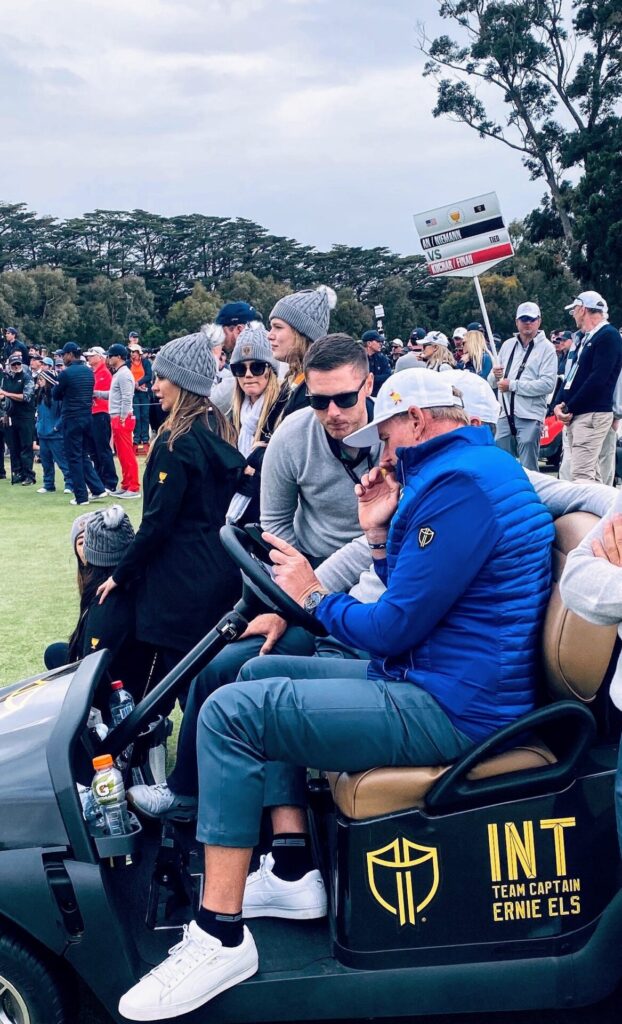
On the back of the incredible European success at Le Golf National, the 15th Club were enlisted by Ernie Els to assist the Internationals Presidents Cup team at Royal Melbourne the following year and again by Pádraig Harrington at Whistling Straits in 2021, though by that time, Beirne had moved on and co-founded his own company called Tour Future.
But Team Europe wanted somebody who’d been part of the team in 2018 involved, so he remained on as an advisor.
That Presidents Cup in 2019 will long be remembered for many reasons, one being that Tiger Woods was captain, picked himself, and was the standout U.S. performer, and another being that it was the one that got away for the Internationals who led 10-8 going into the singles.
It was also the last team competition where the United States didn’t have their own statistical experts heavily involved, and Beirne feels that that, combined with the heavy Ryder Cup defeat the year prior, was a wakeup call.
“I’d like to think it was a factor anyway,” he declared. “I think we always have to be careful of overestimating the impact, both positively and negatively, of it all because it still comes down to the players, you know. The foundation of winning and losing is still how well the players play, and we’re just trying to set them up to do exactly that. But it all sort of feeds together.
“And I remember that year at Sawgrass, there were about 20 International players there, and Ernie brought us in and explained to them what we were doing, why we were doing it, how it was going to work, and he was very clear on it.
“He said, ‘Adam [Scott], if I tell you you’re going to play with Hideki [Matusyama], you’re going to play with him, and that’s that’. It was in a good-spirited way, but it was very clear that this was the plan, he was sticking to it, and whatever happened, happened. But this was all to give them the best possible chance of success, and as much as the statistics helped on paper, when they’re standing on the first tee and they look at the guy beside them, they know that there’s a really clear reason why they’re playing together.”
As much as continuity has been a factor from one European Ryder Cup team to the next with vice-captains becoming captains, and so forth, it’s even more distinct in the Internationals Presidents Cup camp, and Beirne has been retained under Trevor Immelman in ’22, Mike Weir in ’24, and will work closely with Geoff Ogilvy for the 2026 edition at Medinah.
Day-to-day though, he now operates Quantum Sports Data which he founded having sold Tour Futures and their golf-trading models to a large financial company.
“In a nutshell, we’re a golf data analysis company. We’ve put together the most advanced dataset and models in the industry, and we specialise in helping tour players and businesses across the golf world make the most of the data at their disposal,” he explains.
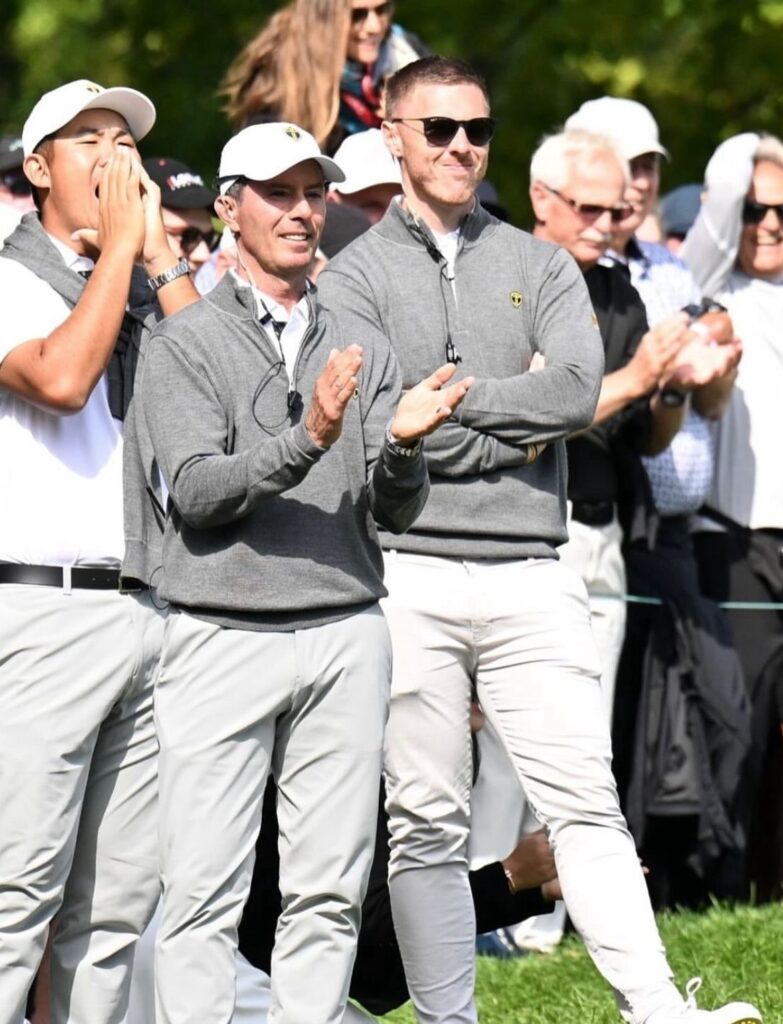
Most tour players are stats conscious and will regularly check their rankings on the PGA Tour or wherever they play, but gradually, more and more are transitioning to the sort of all-encompassing data sets that the likes of Beirne provides.
“I think a lot of them have got to where they are because they’re incredibly good at swinging a golf club,” he shrugged. “And it’s probably hard for them to give up a little bit of control to somebody who might try to convince them that hitting 2-iron instead of driver or vice-versa might be a better option for them on a specific hole, but I think it’ll get there.
“The likes of Matt Fitzpatrick were early adopters and I think he got an edge from it. And I think there is still plenty of edge to be gained for other tour players who haven’t properly engaged with it.”
After all, it’s a numbers game, and hole-by-hole, week-by-week, and year-by-year, you’re always striving for the lowest number possible.
It mightn’t take a mathematical genius with an engineering background to tell you that, but it might take one to tell you how.
The above feature appeared in the 2025-7 edition or Irish Golfer. To view the full edition click below












Leave a comment