









11 of the 12 European Ryder Cup team members have assembled at Wentworth to contest this week’s BMW PGA Championship and will all head transatlantic for a practice session in the aftermath, where, presumably, they’ll be met by Sepp Straka who hasn’t travelled to Europe and who sat out the penultimate FedEx Cup playoff event due to family reasons.
Over 5,000 miles away, 11 of the 12 U.S. team members are doing likewise at the Procore Championship in Napa, California. The odd one out here is Xander Schauffele, whose wife has just given birth to the couple’s first child – a boy named Victor.
And halfway between is the Black Course at Bethpage – the battleground on New York’s Long Island where the 2025 Ryder Cup will be won and lost.
5,000 miles apart, but adopting a similar approach. More similar, at least, than two years ago where just two of the American players – Max Homa and Justin Thomas – teed it up in a competitive event in the four weekends between the PGA Tour’s season-finale at East Lake and the biennial contest which was held at Marco Simone in Rome, whereas all 12 Europeans played at Wentworth a fortnight out and several others played at The K Club the week prior.
Compare and contrast this with Whistling Straits in 2021, when just two weekends separated Tour Championship and Ryder Cup and all 12 Americans played at East Lake before going on to record a record-breaking 19-9 win.
With so many variables in play at a Ryder Cup, it’s impossible to pinpoint any one thing as being the clear decisive factor, but when you lose an opening session 4-0 as the United States did in ’23, it’s fair to suggest they were undercooked. That won’t be the case in ’25, but there are plenty of other ways in which the two sides’ approaches vary wildly.
And maybe the most glaring contrast is in ego – or in ego management, at least.
“We are just 1 of 12,” said Rory McIlroy at Wentworth this week. “We are just 1 of 12, and when we walk in there, we hopefully will make the collective group stronger.”
In other words, you check your ego at the door. It’s been a familiar refrain from European sides in the past – sides that often featured a few bona fide global superstars along with players who American audiences couldn’t pick out in a police lineup, even if were wearing hat, glove and had a putter in their hands.
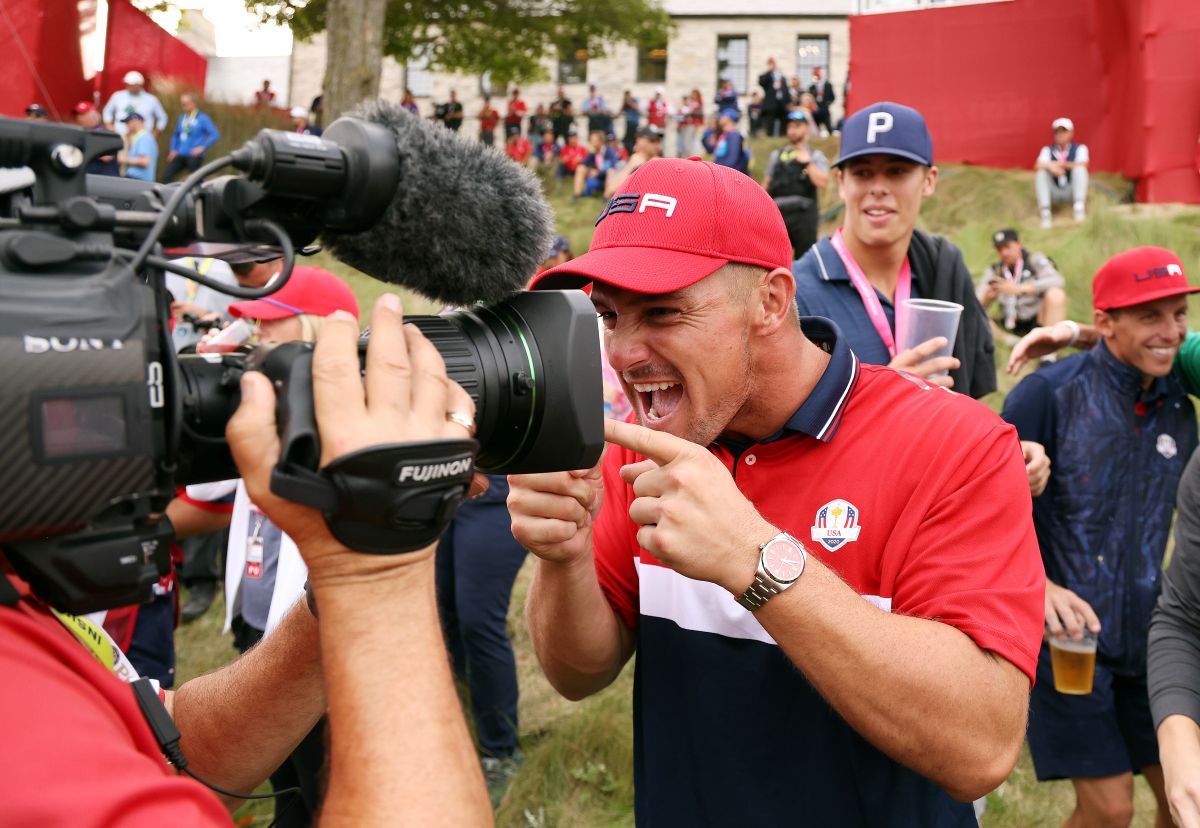
On the other hand, the U.S. side have been encouraged to lean into their egos – at least according to Bryson DeChambeau who addressed the U.S. Walker Cup side at Cypress Point last week where the two-time U.S. Open winner was a heavy presence all week.
“I did speak to Team USA,” Bryson said. “And it’s a similar inspiration that our captain has provided us for the Ryder Cup this year.
“And it’s bringing your ego. Being who you know you are.”
Ego isn’t necessarily a bad thing, especially if ego is a big part of what makes you who you are. And, at the risk of stereotyping, nobody does ego like an American.
If the Walker Cup team took Bryson’s words to heart – and it’s hard to imagine them not taking at least part of what one of the best players in the world was saying – then it served them well. When it came to singles matches, they dominated, winning five-and-a-half points from eight on day one, and eight-and-a-half from 10 on day two.
The danger with leaning into ego is that it’s often momentum dependent. In 2021, they took three points from a possible four in both of Friday’s sessions, and, their egos fed, they continued to push the pedal to the floor. In 2023, as mentioned previously, they got zero points from session one and only one-and-a-half from session two, so leaning into a deflated ego doesn’t offer much support.
But the contrast is part of what makes it such an intriguing event. Arguably, and for maybe the first time in Ryder Cup history, as a collective, the Europeans have greater cause to lean into their egos but that’s not their style. The Americans might hold three of the four major titles at present, but the lower half of the roster is notably weaker.
What’s the better approach? To feed the beast and use it to your advantage, or attempt to take it out of the equation altogether? In just over two weeks’ time, we’ll have the answer.













Leave a comment