
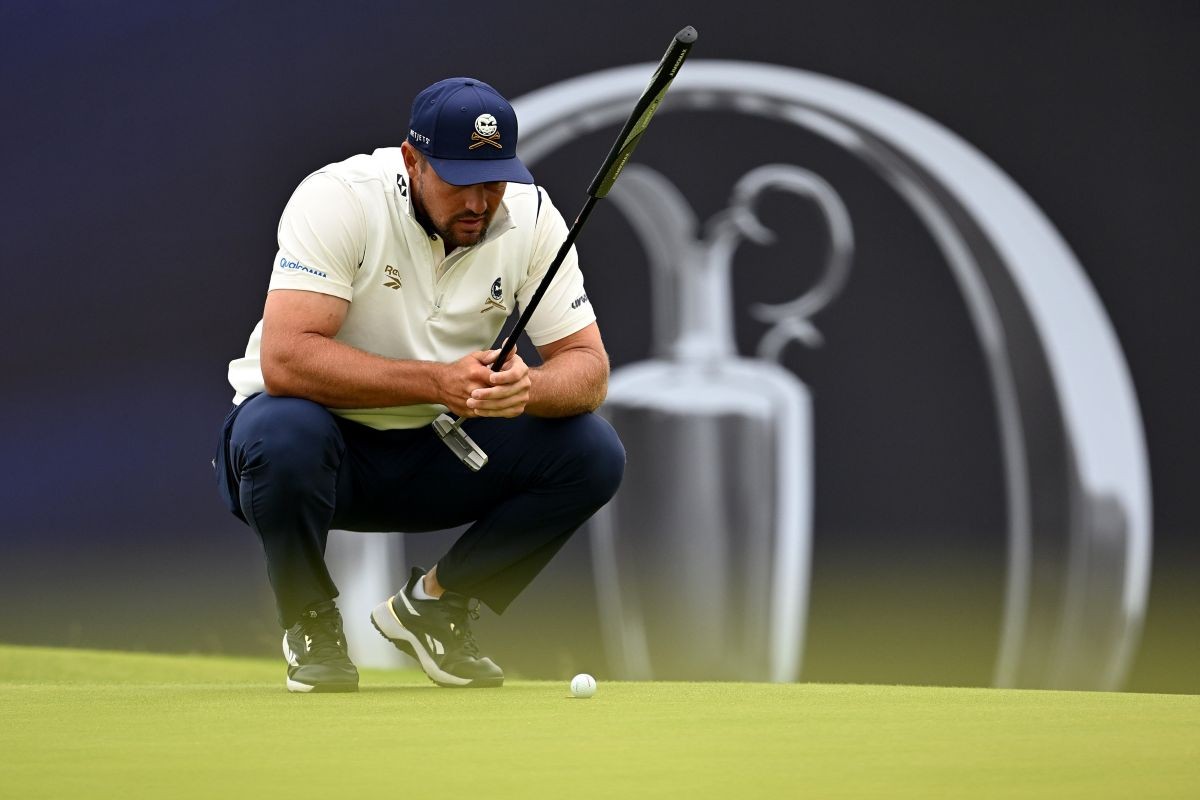








Towards the end of his third round on Saturday morning, Bryson DeChambeau was visibly frustrated.
Partly because he had cruised through the front nine in 33 strokes, only to fade on the back, but mainly because he and his group were being timed by officials. DeChambeau disagrees with how golf’s governing bodies enforce pace of play.
Once again, pace of play has loomed over a major championship, with many of Thursday’s rounds creeping towards (and some even past) the six-hour mark. The reasons are numerous — the course routing, the types of holes, the speed of the greens, the length of the rough — and we’ve heard them all before. What about the stakes of the match? There are Ryder Cup implications, FedEx Cup implications, and career legacy implications, too.
Pace has become one of the most discussed topics in professional golf. The PGA Tour is limiting the number of players in the field at tournaments next spring because there often isn’t enough daylight to get everyone around the course in time. Yet, for all the discussion, it rarely meets with any real solutions.
Enter DeChambeau.
Speaking after his third round, where he shot 68, DeChambeau explained not only why being put on the clock was frustrating but also offered a simple fix he’d love to see implemented. On his Saturday timing, DeChambeau believed he had played into a spot of trouble on the 16th, the long par-3 called Calamity Corner. He ground out a par while the group ahead played the short, drivable par-4 17th in a collective one under.
“He said we just kept losing time,” DeChambeau explained. “Unfortunately on the 16/17 exchange, you’ve got a downhill, drivable hole you can play pretty quick if you get it in the right spot. They did that and we just lost more time to the group in front of us. They put us on the clock, which was unfortunate.”
He managed well, finishing with a couple of pars, but brought his thinking cap to the interview area.
As a player who has explored ways of changing the game, I began, or venturing into new aspects of the game, pace of play seems to be something that can’t be figured out. Is it one of those things?
“It’s very simple,” DeChambeau said. “It’s not difficult at all. You individually time everybody for their entire round. It’s very simple. Nobody wants to do it. Because people are too scared to get exposed. Which, I’m an advocate for. I’d love to be timed, and I have no problem with that. My putting — I’m more deliberate and take more time on that. But when it comes to iron shots and off the tee, I’m pretty fast.”
DeChambeau cited Dustin Johnson, who seems to him to be “incredibly fast” on full-swing shots, but “really slow” on greens. Everyone is different, but that’s how much of professional golf is played. Mostly plodding on the greens, mostly quick elsewhere. But not for everyone. In most cases, pace of play comes down to one group falling behind the group ahead of them. When that happens, the group will be monitored, and if any player takes too long to play a shot — most often 40 seconds when it is their turn — they will be put “on the clock.” Further infractions of that pace can lead to a penalty, which is incredibly rare.
DeChambeau wants the timing to be done from the very first tee shot until the final putt drops.
What would we find out in that new system, I asked.
“I think it would be more fair towards everybody,” DeChambeau replied. “You know if somebody is playing slower, the [official] can go up to them and say, ‘Hey man, you’re over par with your time.’ All you do is you just time them for every shot — he gets there, puts the bag down, and how long it takes them to hit that shot. And how long it takes them to walk to the green. It’s not rocket science. You time how long someone takes individually and then you separate that from the other person playing. You start-stop on them the whole entire thing.”
DeChambeau believes that, given the number of marshals and officials walking with groups during the biggest events in the sport, there would be no issue adding a stopwatch to the action.
“You know, it’s one way. I’m not saying it’s the answer,” he said. “I’m definitely not somebody that has the most knowledge or experience on it. You know if somebody has a different way of monitoring it, I hope there’s just a better system out there at some point in time.”
This article originated on Golf.com












Leave a comment